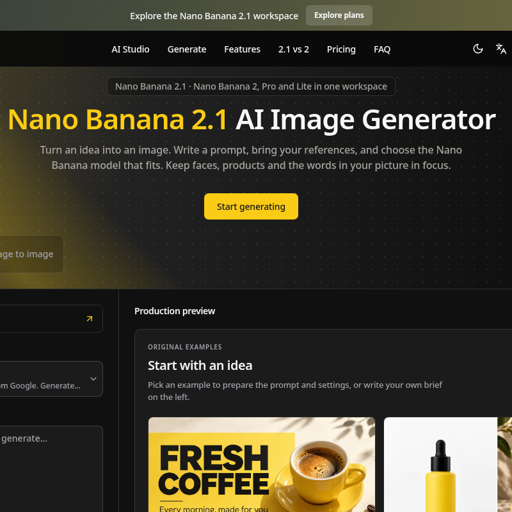
Nano Banana 2.1 Pro verdict
Best for solo creators who want access to Nano Banana 2.1's multi-reference editing and 4K output without wiring up a Google API account directly. The credit system adds a markup layer on top of Google's own API costs, and the workspace offers no subscription tier, only one-time credit packs. Developers or teams who can manage API keys directly will get better per-image economics by going straight to Google.
Strengths
One-time credit packs with no auto-renewal required, making it easy to cap spending on a single project without a subscription commitment.
Supports up to 14 reference images per generation, matching the full capability of the underlying Nano Banana 2.1 model for character and object consistency.
Weaknesses
The site adds a credit markup on top of Google's own API rates: at 28 credits per 4K image and $25.99 for 1,500 credits, each 4K image costs roughly $0.49 through this workspace versus $0.113 at Google's standard API rate, a more than 4x premium.
No subscription tier exists in the current pricing structure, so heavy users cannot lock in a lower per-credit rate the way monthly plans on competing platforms allow.
Midjourney verdict
Midjourney suits individual creators, designers, and agencies who want richly stylized visuals and flexible GPU-hour billing. It lacks API access and centralized team management, so studios needing those should consider Leonardo.Ai or GPT Image 2. Skip it if you need enterprise features like SSO or seat pooling.
Strengths
Stylized, high-quality image and SD/HD video output using V8.1 model.
Flexible GPU-hour billing with fallback Relax mode in mid-tiers.
Weaknesses
No API or enterprise features like SSO or seat pooling, teams must manage individually.
GPU-hour model can be confusing; fast hours don’t roll over and extras cost $4/hour.