The Agentic Coding Kit verdict
Solo developers who already use Claude Code or Cursor and want opinionated guardrails without writing their own config files will get real value from this $19 pack. It covers five stacks and ships ready-to-run git hooks and CI templates, but it does nothing for developers on other AI coding tools and offers no team-sharing or update mechanism beyond a zip file. If you need a full agentic coding environment rather than a config layer on top of one you already pay for, Cursor itself is the better starting point.
Strengths
One-time $19 price with free v1.x updates covers five stacks and eight distinct rule categories, making the per-stack cost under $4.
All 34 files are plain Markdown, JSON, or shell with no proprietary runtime, so you can read, edit, and version-control every rule before trusting it.
Weaknesses
Hard dependency on Claude Code or Cursor: the kit does nothing for developers on GitHub Copilot, Gemini CLI, or any other AI coding tool, which is a significant constraint given how fragmented the market is.
Distributed as a 25 KB zip with no automated update channel; getting v1.x updates means manually re-downloading and diffing against your already-customized files.
Solo Ship Kit verdict
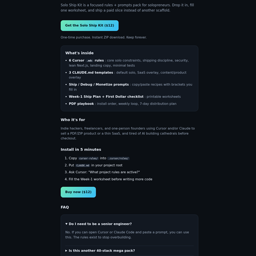
Solo Ship Kit is the right buy for a solo founder who keeps letting AI sessions drift into architecture instead of a checkout page. At $12 one-time it costs less than an hour of most freelancers' time, but it is a config pack, not a tool, and it does nothing Cursor or Claude cannot already do if you write your own rules. Anyone building beyond a thin SaaS or a PDF product, or anyone who wants ongoing updates and community support, should look at The Agentic Coding Kit instead.
Strengths
Single $12 payment with no subscription and a perpetual license covering unlimited personal and client use.
Six purpose-built Cursor.mdc rules and three CLAUDE.md templates cover the most common overbuilding failure modes for solo founders: scope creep, premature abstraction, and skipping the checkout step.
Weaknesses
The rules work by steering model context, not by enforcing hard stops. A long session or a model that deprioritizes system instructions can drift past them with no warning, which is a structural limitation specific to prompt-based rule packs versus hook-based enforcement.
No free tier, no trial, and no refund policy is mentioned on the pricing page. At $12 the risk is low, but buyers cannot evaluate the actual rule content before purchasing.