LifeFrom
A longitudinal personal health record that reads your blood, DNA, scans, and wearables together and explains what they mean for your stated
Are you the maker? Claim this listing to keep info, pricing and screenshots current. Verified via your tool's domain email.
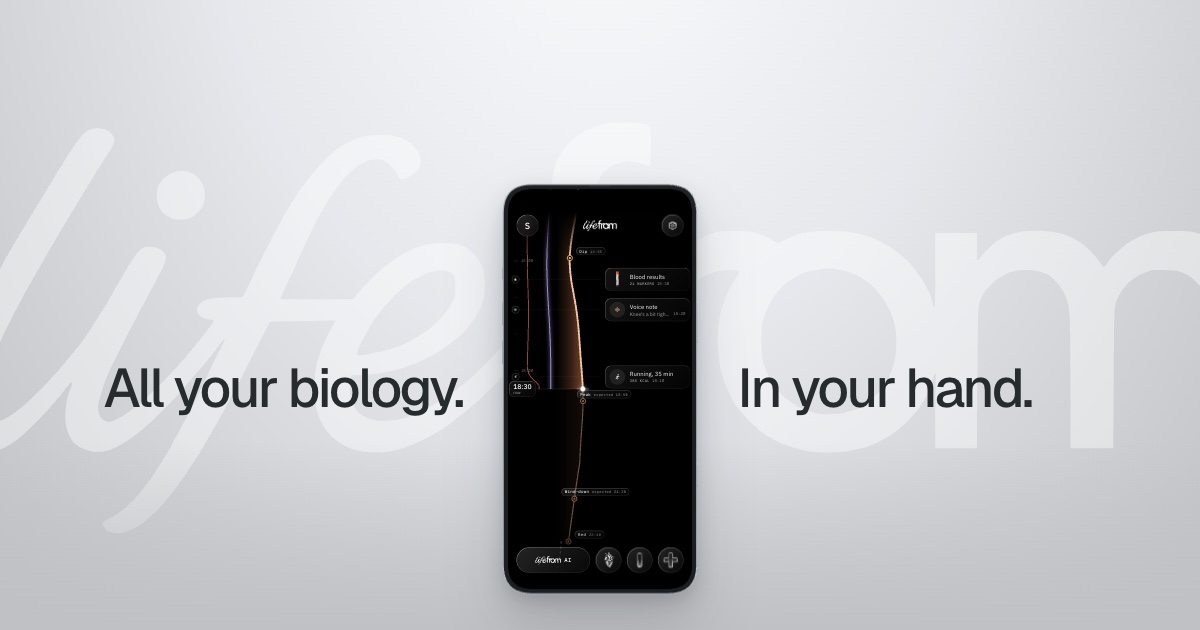
LifeFrom is the most ambitious personal health record app currently in free beta, built for people who already have blood panels, DNA raw data, and wearables and want one place that reads them together. Its Apple Health dependency and iOS-only data pipeline mean Android users and anyone without lab data get far less value. If you want a general-purpose health chat assistant rather than a longitudinal biological record, ChatGPT or Claude will serve you better without requiring you to upload sensitive medical files.
What is LifeFrom?
LifeFrom is an AI-powered personal health record platform, currently in free beta, that consolidates biological data from multiple sources onto a single private longitudinal record. It accepts blood panel uploads, raw DNA files from 23andMe, AncestryDNA, and MyHeritage, gut microbiome reports, medical scans and images, Apple Health wearable data, and supplement and prescription logs. An AI layer reads each data type in context alongside the others, explains markers in plain language, and tracks progress toward a user-defined health goal such as improving metabolic age, sleep quality, or fertility.
The platform computes a daily metabolic age estimate from connected Apple Health data, covering sleep, heart rate, activity, and additional markers. Users can photograph meals, skin conditions, or labels and add voice notes directly to their record. The supplement and medication module shows pharmacokinetic timing, potential interactions, and correlations with sleep and lab results. LifeFrom explicitly states it does not diagnose or prescribe.
How we scored LifeFrom
Capability scores 18 because the feature set, reading DNA variants, blood panels, scans, microbiome results, and Apple Health data together in one longitudinal record, is genuinely broader than any named competitor in the directory for this specific use case. It loses points because the Android exclusion cuts the addressable user base in half and the scientific basis for the metabolic age and ATP calculations is not disclosed. Ease of use scores 15 because uploading raw DNA files, medical scans, and blood panels is a high-friction onboarding process that most users will find daunting, and beta-stage polish is typically uneven. Value scores 17 because free-during-beta is genuinely generous for the feature depth offered, but the complete absence of post-beta pricing information makes it impossible to assess long-term value, and users are committing sensitive data to a product whose future cost is unknown. Delivery scores 12 because the product is in beta with no stated data-retention guarantees, no published continuity commitments, and no disclosed scientific citations for its core computed markers, all of which are meaningful trust gaps when the ask is to upload MRI scans and raw DNA.
Pros and cons
What we liked
- Reads blood panels, raw DNA variants, microbiome reports, and medical scans together in one record rather than treating each as a separate app silo.
- Daily metabolic age recalculation from Apple Health data gives a continuously updated biological baseline, not a one-time snapshot.
- Supplement and medication module shows pharmacokinetic timing, interaction flags, and correlations with sleep and lab results, a level of specificity rare in consumer health apps.
Where it falls short
- The entire metabolic age engine and daily recalculation pipeline depend on Apple Health, which locks out Android users completely and makes the core value proposition unavailable to roughly half the smartphone market.
- Beta status means no disclosed post-beta pricing, no stated data-retention guarantees, and no published uptime or continuity commitments, which is a real risk when users are uploading MRI scans and raw DNA files.
- No web search or cited external knowledge base is surfaced to the user during conversations, so claims about what a marker means or what moves a goal cannot be independently verified within the app the way they can with Perplexity or similar research-oriented tools.
Key features
Who should use LifeFrom?
LifeFrom is built for people who have already accumulated health data and feel like none of their apps talk to each other. A 40-something who has done a 23andMe test, gets annual blood panels, wears an Apple Watch, and takes a handful of supplements is exactly the user the product is designed around. The goal-setting structure also makes it a reasonable fit for someone managing a specific condition or training target, such as a perimenopausal woman tracking symptoms alongside labs, or a recreational athlete who wants to see how sleep and nutrition actually correlate with performance markers.
If you want a conversational AI that can answer general health questions without requiring you to upload sensitive files, ChatGPT or Claude are safer starting points with no data-upload commitment. Android users should look elsewhere entirely: the metabolic age engine and daily recalculation depend on Apple Health, and there is no stated Android roadmap. Anyone uncomfortable placing MRI scans and raw DNA on a beta platform with unspecified post-beta pricing should wait for a stable release.
Skip it if: Android users, casual health chatters, or anyone not ready to upload sensitive medical records to a beta product
LifeFrom alternatives
Frequently asked questions
Is LifeFrom free to use?+
Yes, LifeFrom is free during its beta period. No paid tiers are listed on the pricing page as of October 2026, and post-beta pricing has not been announced.
Which DNA testing services does LifeFrom support?+
LifeFrom accepts raw data exports from 23andMe, AncestryDNA, and MyHeritage. An illustrative report on the site references 601,782 variants read and 109 highlighted genes from a sample file.
Does LifeFrom work on Android?+
The metabolic age calculation and daily biological tracking depend on Apple Health, which is iOS-only. No Android integration is mentioned on the site, so Android users cannot access the core tracking features.
Does LifeFrom diagnose medical conditions?+
No. The site explicitly states the product does not diagnose or prescribe. It reads and explains markers in plain language and tracks progress toward user-defined goals.
What kinds of medical files can I upload?+
The site lists MRI images, PET scans, X-rays, EKGs, blood panel reports, gut microbiome test results, and raw DNA files as supported import types.
How does the supplement tracking work?+
You log supplements and prescriptions and LifeFrom shows when each one peaks, how long it lasts, what it may interact with, and how it correlates with changes in your sleep, heart data, and lab results. It also sends dosing reminders.
More AI Chatbots & Assistants tools
See all categoriesGet your tool listed on 300+ directories.
One listing here is a strong start. But the founders who get discovered everywhere are listed everywhere. Our sister site, Free AI Directories, submits your tool to 300+ AI directories for you, every single one by hand, by a real person.
It is a one-time payment of $49, no subscription, and you can follow along as the submissions land. Prefer the slow route? The same site keeps a free list of 450+ directories you can work through yourself.
Get my tool listed on 300+ directoriesOne-time payment, no subscription · 100% human submissions · Free list of 450+ directories included.