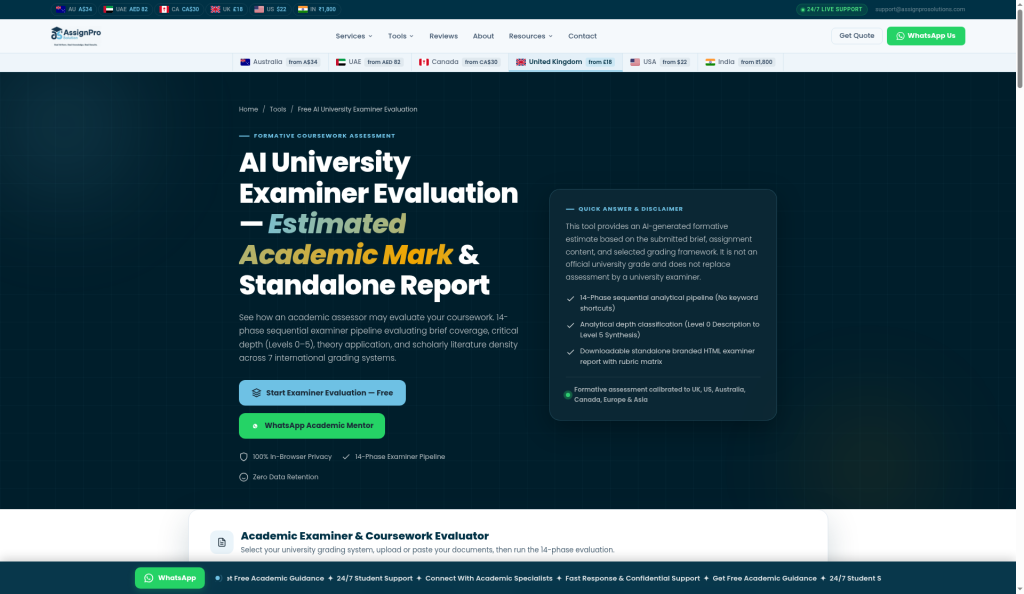
AssignPro AI Grade Estimator verdict
Students preparing coursework for UK, US, Australian, Canadian, EU, or Indian universities get the most from this tool: it maps their draft against the grading framework they will actually be marked on, which most generic writing tools do not do. The 14-phase pipeline is a genuine differentiator on paper, but there is no independent evidence yet on how accurate its estimates are in practice. Anyone who needs grammar correction, citation help, or actual writing improvement should look at Grammarly instead.
Strengths
Covers seven distinct international grading frameworks in a single free tool, including UK QAA, Australian AQF, and Indian UGC CGPA, which most writing assistants ignore entirely.
The 14-phase sequential pipeline with Level 0 to Level 5 analytical depth classification is a more structured evaluation approach than a simple rubric tick-box, and the output is a downloadable standalone HTML report rather than an on-screen summary that disappears.
Weaknesses
There are no independent reviews, published accuracy benchmarks, or third-party validation of how closely the tool's estimated marks align with real university examiner grades. A student who calibrates their submission strategy around a tool-generated estimate is taking an unverified risk.
The tool is operated by a company whose primary revenue comes from paid assignment help and dissertation tutoring services. The free grade estimator functions as a lead-generation funnel toward those paid services, which is a structural conflict of interest worth noting when interpreting its feedback.
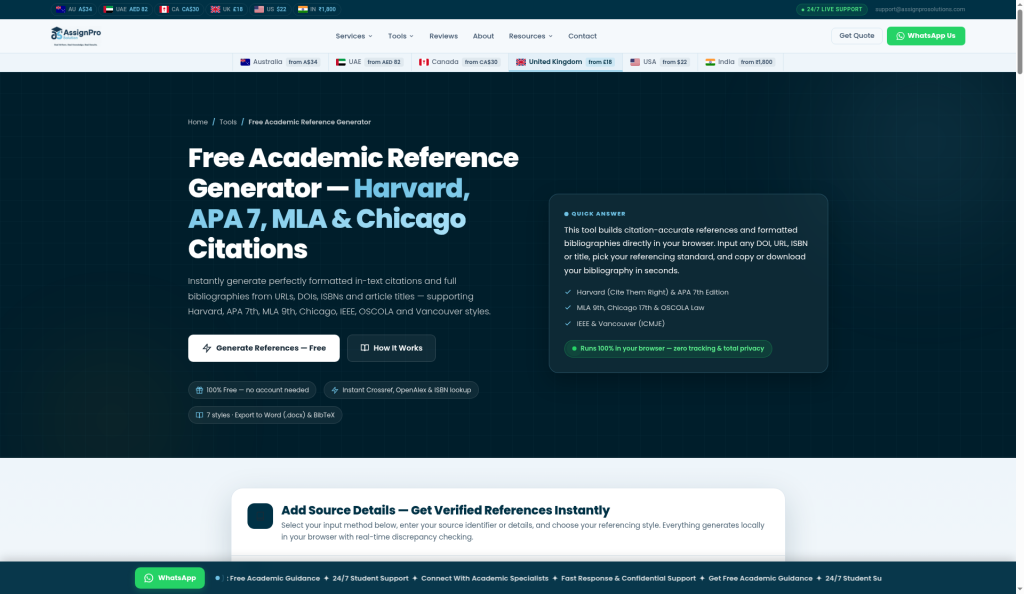
AssignPro Free Reference Generator verdict
Students who need quick, correctly formatted citations without signing up or paying anything will find this genuinely useful, especially for OSCOLA and Vancouver styles that many free tools skip. It runs entirely in the browser with no server-side data storage, which is a real privacy advantage over cloud-based rivals. Researchers who need bulk processing, Zotero-style library management, or an API should look elsewhere.
Strengths
Covers OSCOLA and Vancouver in addition to the standard APA/MLA/Chicago trio, filling a genuine gap in the free-tool market for law and medical students.
Runs entirely in the browser with zero tracking and no account required, so no personal data is collected or stored server-side.
Weaknesses
No reference library or save functionality: every session starts blank, so students building a bibliography across multiple sessions must export and re-import each time.
The tool is a side feature of a paid assignment-help business, with no public changelog or style-guide update schedule, making it hard to verify whether APA 7th or MLA 9th implementations stay current with edition revisions.