DeepVal
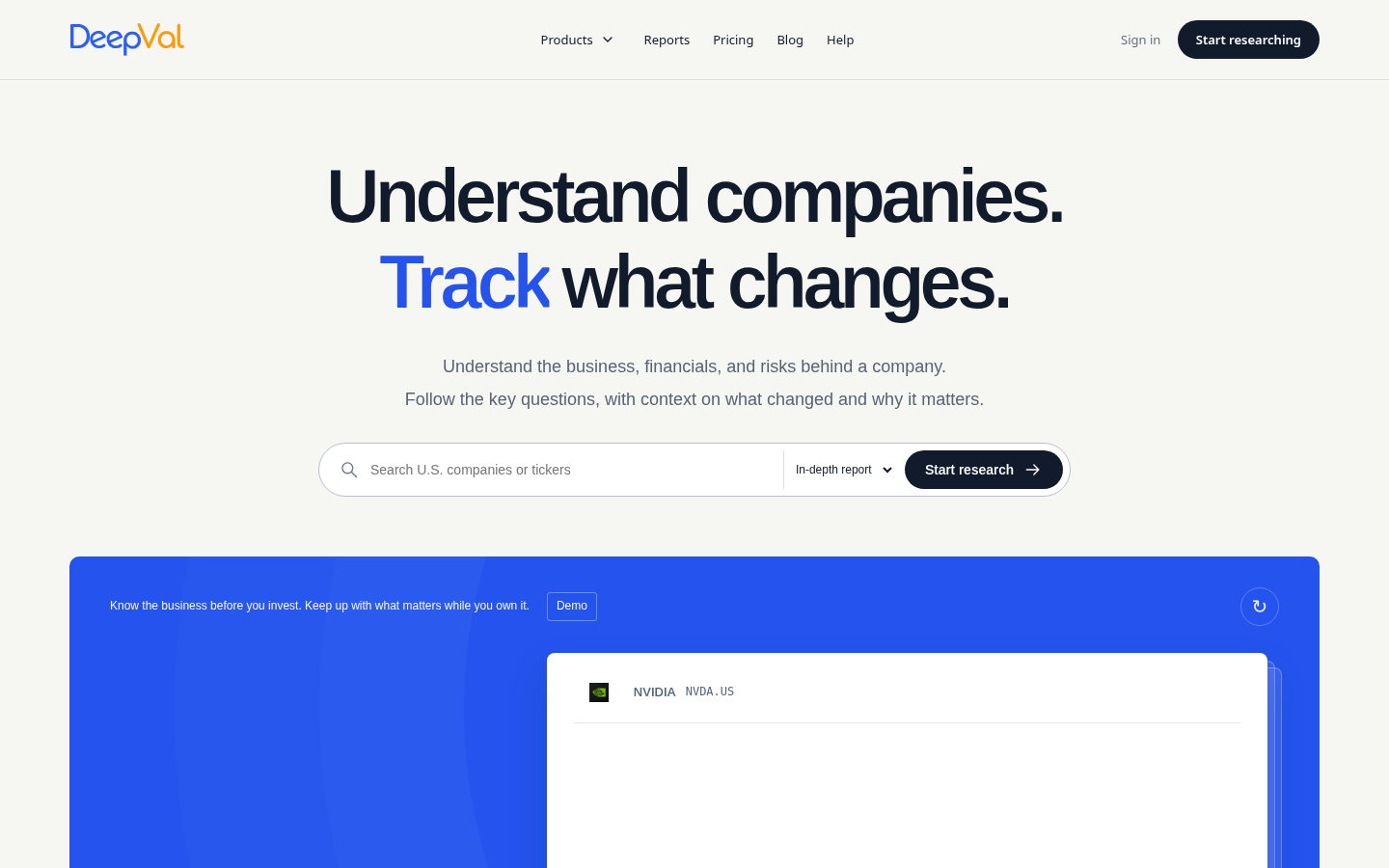
AI-powered company research for long-term investors: structured reports on U.S.-listed companies plus ongoing tracking of key questions.
Are you the maker? Claim this listing to keep info, pricing and screenshots current. Verified via your tool's domain email.
DeepVal is the right fit for self-directed, long-term investors who want a structured value-investing framework applied to U.S.-listed companies, not a chatbot that answers ad hoc questions. Its point-based consumption model means heavy users on the free tier will hit the 20-point ceiling fast, and the annual Pro plan at $299/year locks you into a 72-hour refund window. Investors who need multi-market coverage or want traceable source citations on every claim should look at AlphaVue instead.
What is DeepVal?
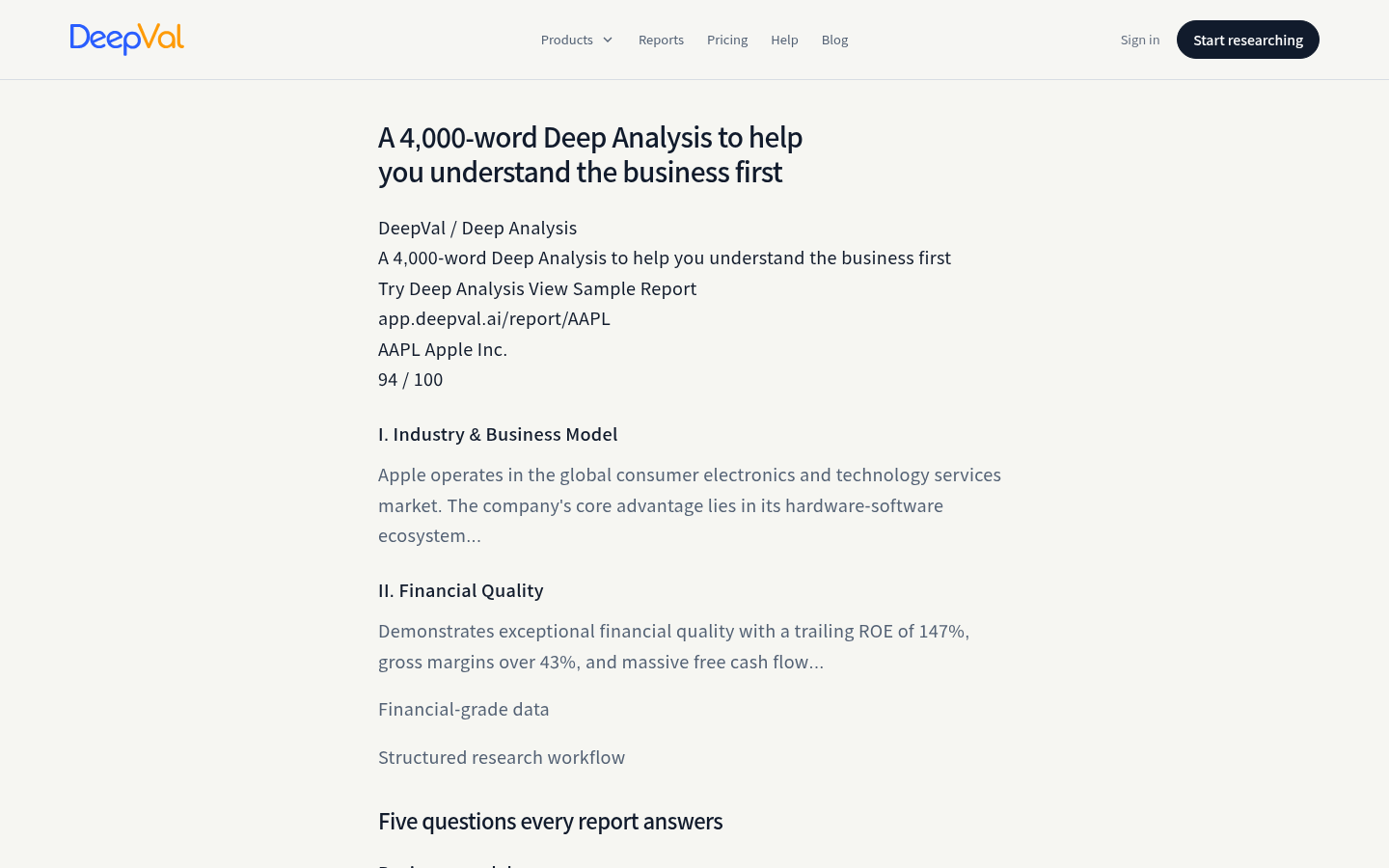
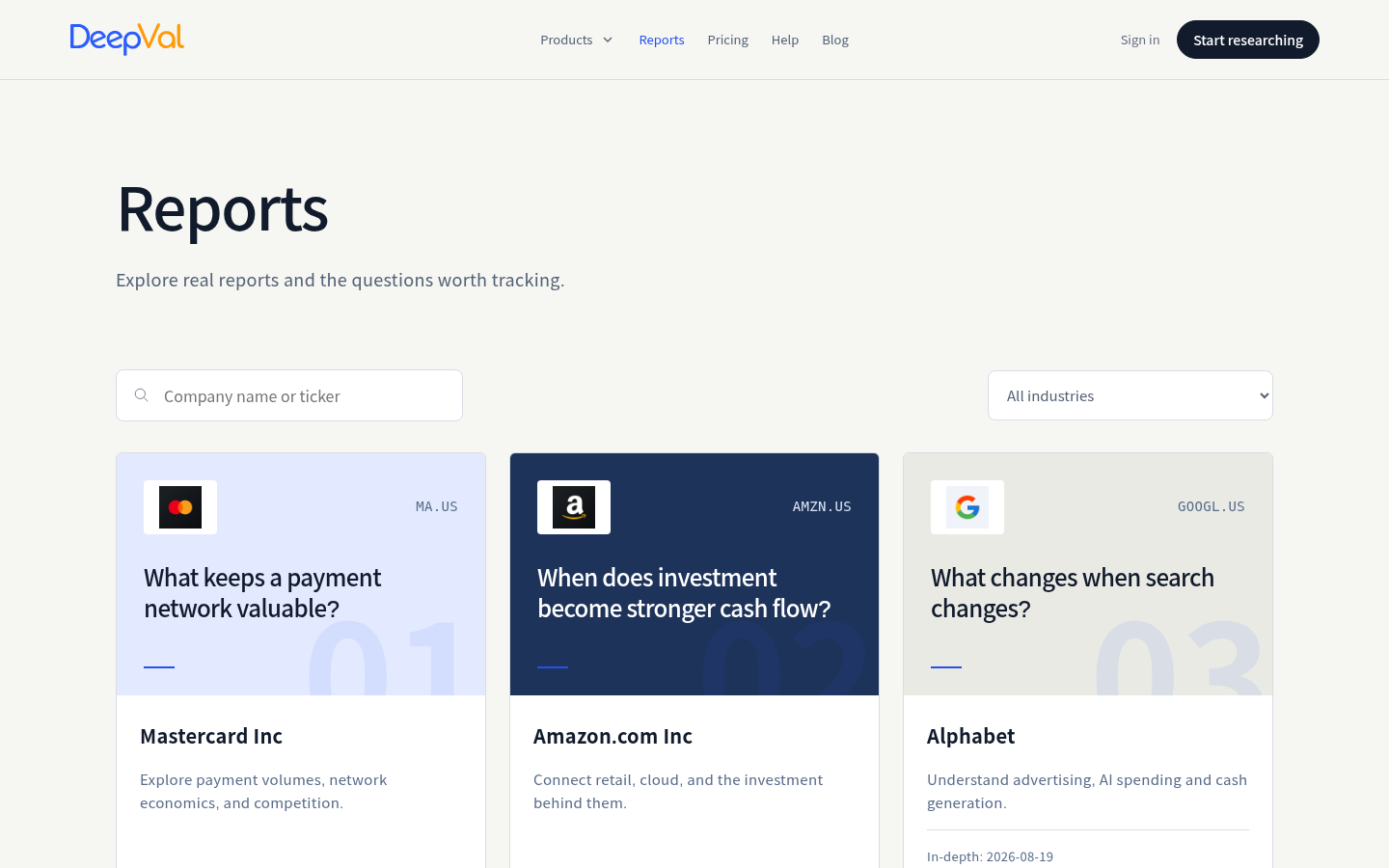
DeepVal is a web-based AI research assistant aimed at individual investors who apply value-investing principles to U.S.-listed stocks. It generates two types of structured reports: a Deep Analysis covering business model, financial quality, valuation, and key risks at roughly 4,000 words, and a Moat report examining competitive position, industry structure, and profitability quality. Both reports draw on financial-grade data, SEC filings, and earnings call transcripts.
Beyond one-time reports, DeepVal offers continuous tracking: it extracts key questions from each report, monitors them on a schedule, and delivers weekly summaries of material changes. Access is governed by a research-points system, with the free plan providing 20 points and paid plans ranging from 300 to 2,700 points per month. The platform also includes value-screening tools that filter companies by financial quality, dividend yield, growth durability, and balance sheet strength.
How we scored DeepVal
Capability scores 18 because the value-investing framework and dual-report structure (Deep Analysis plus Moat) are genuinely differentiated for the long-term investor audience, but U.S.-only coverage and the absence of traceable per-claim sourcing are real gaps versus AlphaVue. Ease of use scores 19 because the workflow is clearly structured around a defined research sequence rather than open-ended prompting, which lowers friction for the target user. Value scores 16 because the point-expiry policy is a structural penalty that most subscription research tools do not impose, and the free plan's 20-point ceiling is thin enough to be a single-session trial rather than a usable ongoing tier; the Pro annual plan at $299/year is reasonable if you use it consistently, but the no-rollover rule punishes irregular users. Delivery scores 15 because no independent user reviews or third-party coverage were found, making it impossible to verify whether the reports deliver on their stated depth and data quality; the short refund windows (24 to 72 hours) also limit recourse for buyers who discover limitations after use.
Pros and cons
What we liked
- Structured value-investing framework applied consistently: every Deep Analysis answers the same five questions (business model, financial quality, valuation, key risks, margin-of-safety verdict), making reports comparable across companies rather than free-form summaries.
- Continuous tracking with weekly summaries is built into the product, not bolted on; you choose which key questions to monitor after reading the report, and DeepVal checks them on a schedule.
- Annual plans offer meaningful savings: the Pro plan drops from $29/month to the equivalent of roughly $24.92/month ($299/year), and the Ultra plan from $119/month to roughly $99.92/month ($1,199/year), with a 72-hour full refund window on annual purchases.
Where it falls short
- Research points expire at the end of each billing period with no rollover, so a month where you run fewer reports than planned means you simply lose that capacity; this is a structural penalty unique to DeepVal's consumption model that most subscription research tools do not impose.
- Coverage is hard-limited to U.S.-listed companies; there is no indication of plans to expand, which rules out the tool for anyone with international holdings.
- The free plan's 20-point ceiling is low enough that a single in-depth report plus a moat report could exhaust it, making the free tier more of a one-time trial than a usable ongoing plan.
Key features
DeepVal pricing
Free plan includes 20 research points and tracks 1 company at a time. Paid plans run $29/month (Pro, monthly) up to $119/month (Ultra, monthly), or $299 to $1,199/year on annual billing. Points expire at the end of each billing period and do not roll over.
| Plan | Price | Who it is for |
|---|---|---|
| Free | $0 | 20 research points (one-time on sign-up), 1 company tracked at a time. Enough for a single deep report or moat report to evaluate the product. |
| Pro (Monthly) | $29/month | 300 research points per month, 8 companies tracked simultaneously. Points expire at end of billing period. |
| Pro (Annual) | $299/year | 300 research points per month, 8 companies tracked simultaneously. Approximately $24.92/month. Points issued monthly, expire at end of each billing period. 72-hour full refund window. |
| Max (Monthly) | $59/month | 900 research points per month, 24 companies tracked simultaneously. |
| Max (Annual) | $599/year | 900 research points per month, 24 companies tracked simultaneously. Approximately $49.92/month. |
| Ultra (Monthly) | $119/month | 2,700 research points per month, 72 companies tracked simultaneously. |
| Ultra (Annual) | $1,199/year | 2,700 research points per month, 72 companies tracked simultaneously. Approximately $99.92/month. |
Pricing reflects what we saw at time of review (2026-10). Always confirm current pricing on the tool's own site.
Who should use DeepVal?
DeepVal suits the individual investor who does their own fundamental research before buying and wants a structured starting point rather than a raw data dump. A retired professional managing a concentrated portfolio of 8 to 24 U.S. stocks, for example, would get real use from the Pro or Max plan: structured reports on each position plus weekly alerts when something material shifts. The value-investing framework is opinionated in a useful way for this audience; it asks the same five questions every time, which makes reports comparable across companies.
Investors who need coverage of non-U.S. markets, want to see the exact source behind every claim, or are running quantitative screens across hundreds of tickers will find DeepVal too narrow. For traceable, multi-agent research with explicit evidence chains, AlphaVue is the stronger choice in our directory. Traders looking for price signals or momentum data should skip DeepVal entirely; it does not provide that and says so plainly.
Skip it if: Investors needing non-U.S. coverage, real-time trading signals, or per-claim source citations
Frequently asked questions
What are research points and how many does a report cost?+
Research points are the currency that pays for in-depth and moat reports. The free plan includes 20 points total; paid plans issue 300 to 2,700 points per month. The exact point cost per report is not publicly listed on the pricing page, so check the in-app documentation before committing to a tier.
Do unused research points carry over to the next month?+
No. The pricing page states explicitly that membership points expire at the end of each billing period and do not roll over. This applies to all plans, including annual ones.
Can I get a refund if I change my mind?+
Yes, with conditions. Monthly plans allow a full refund within 24 hours of payment; annual plans allow 72 hours. The refund is voided if more than 20 points have been successfully used on that order.
Does DeepVal cover non-U.S. stocks?+
Based on all available product information, DeepVal covers U.S.-listed companies only. No international market coverage is mentioned anywhere on the site.
Is this investment advice?+
No. DeepVal states clearly that it provides research information only and does not provide personalized investment advice, execute trades, or manage money.
What is the difference between the Deep Analysis and the Moat report?+
The Deep Analysis is a ~4,000-word report covering business model, financial quality, valuation, and risks with a margin-of-safety verdict. The Moat report focuses specifically on competitive position: industry structure, market share, profitability quality, and whether a durable advantage actually exists.
More AI Business Tools
See all categoriesGet your tool listed on 300+ directories.
One listing here is a strong start. But the founders who get discovered everywhere are listed everywhere. Our sister site, Free AI Directories, submits your tool to 300+ AI directories for you, every single one by hand, by a real person.
It is a one-time payment of $49, no subscription, and you can follow along as the submissions land. Prefer the slow route? The same site keeps a free list of 450+ directories you can work through yourself.
Get my tool listed on 300+ directoriesOne-time payment, no subscription · 100% human submissions · Free list of 450+ directories included.