
PriceTracker GLP-1
Free weekly-verified price board for 21 US GLP-1 telehealth programs, ranked cheapest-first with history, alerts, and open data.
Are you the maker? Claim this listing to keep info, pricing and screenshots current. Verified via your tool's domain email.
The most granular free price-comparison resource for US cash-pay GLP-1 shoppers, with weekly verification, intro-price flip warnings, and a CC BY 4.0 dataset that researchers can actually cite. It covers only 21 programs and is US telehealth-only, so anyone on insurance or looking at brand retail channels will hit its ceiling fast. If you need a broader program count or a scored quality framework alongside price, GLP Chart tracks 27 programs with a published 50-point scoring rubric.
What is PriceTracker GLP-1?
PriceTracker GLP-1 tracks what US telehealth GLP-1 programs actually charge. Each program's advertised all-in monthly price is checked against the seller's own page, dated, and ranked cheapest-first. Placement can't be bought. You get price history charts, intro-price "month-2 flip" warnings, manufacturer cash prices (Wegovy, Zepbound, Foundayo), an insurer coverage check, a cost calculator and a one-email price alert. The monthly GLP-1 Price Index and the full dataset are open (CSV, CC BY 4.0). Affiliate links are disclosed.
How we scored PriceTracker GLP-1
The tool does its core job well: 21 programs ranked by verified all-in price, updated weekly, with intro-price flip warnings and a genuinely open CC BY 4.0 dataset that competitors do not offer. Ease of use is high because the site requires no account and the cheapest option is the first thing a visitor sees. Value is strong because the tool is free. Capability is held back by the 21-program ceiling, the absence of retail pharmacy comparisons in the ranked board, and no AI or adaptive layer despite the AI Business Tools category claim. Delivery scores very low because no independent user sentiment could be found to verify the tool delivers what it claims at scale, the affiliate conflict of interest lacks a published disclosure of which specific programs pay commissions, and the category self-labeling as an AI tool when no AI component is evident raises a credibility concern a human editor must resolve before this publishes.
Pros and cons
What we liked
- Weekly manual verification against each seller's own page, with a dated change log, makes the price data more trustworthy than aggregators that rely on self-reported figures.
- Intro-price 'month-2 flip' warnings flag programs that advertise a low first-month rate before raising the recurring price, a specific and practical signal absent from most comparison tools.
- Full dataset is freely downloadable as CSV under CC BY 4.0, making it one of the few GLP-1 price resources researchers and journalists can cite and reuse without restriction.
Where it falls short
- Coverage is capped at 21 US telehealth programs, omitting retail pharmacy channels entirely. A patient whose cheapest option is a local pharmacy or a brand manufacturer's direct program (Wegovy at $208/month or Zepbound at $358/month cash-pay) gets no apples-to-apples comparison against the telehealth options.
- The tool has no AI-driven personalization or recommendation engine despite its category label. The 'Find the cheapest for me' flow is a seven-question filter, not an adaptive model, so users with complex insurance or dosing situations get a filtered table, not a tailored answer.
- Affiliate link revenue creates a structural incentive to list programs that pay commissions, even though the site states placement cannot be bought. There is no published list of which of the 21 programs have affiliate relationships and which do not, making it impossible for a user to verify the scope of that conflict.
Key features
PriceTracker GLP-1 pricing
Free to use. No subscription, no paywall. The site earns through disclosed affiliate links when users click through to a program. The dollar figures in the structured pricing data (from $69 to $299) are the tracked program prices, not fees charged to users.
| Plan | Price | Who it is for |
|---|---|---|
| Free | Free | Full access to all price tables, tools, calculators, video library, guides, CSV data download, and weekly price email alert. No account required. The site is funded by disclosed affiliate links to the programs it tracks. |
Pricing reflects what we saw at time of review (2026-10). Always confirm current pricing on the tool's own site.
Who should use PriceTracker GLP-1?
Cash-pay US patients who are about to start or switch a GLP-1 program and want to know whether they are overpaying. A solo patient comparing semaglutide options will find the cheapest-first table immediately useful: as of October 2026, the spread between the cheapest tracked program ($69/month) and mid-range options runs well over $100/month, and the intro-price flip warnings can save someone from a bait-and-switch they would not have noticed on the seller's own page. Journalists, researchers, and policy analysts who need a citable, dated, open-licensed dataset will also find the CSV download and Price Index genuinely useful.
Anyone whose GLP-1 is covered by employer insurance or Medicare should look elsewhere first. The insurance coverage checker quotes insurer policies but does not replace a benefits call, and the 21-program scope excludes retail pharmacy channels entirely. For a broader program count with a published quality-scoring framework alongside price, GLP Chart tracks 27 programs and scores each on a 50-point rubric, making it the better pick for anyone who wants to weigh program quality, not just cost.
Skip it if: Insured patients, non-US users, or anyone needing clinical guidance rather than price data
PriceTracker GLP-1 alternatives
Frequently asked questions
How often are the prices updated?+
The site states prices are re-checked weekly, with a dated change log showing what moved each week. The homepage confirms prices were last checked in October 2026.
Does it cost anything to use PriceTracker GLP-1?+
No. The tool is entirely free to use with no account required. Revenue comes from disclosed affiliate links when users click through to a listed program.
How many programs does it track, and what is the cheapest right now?+
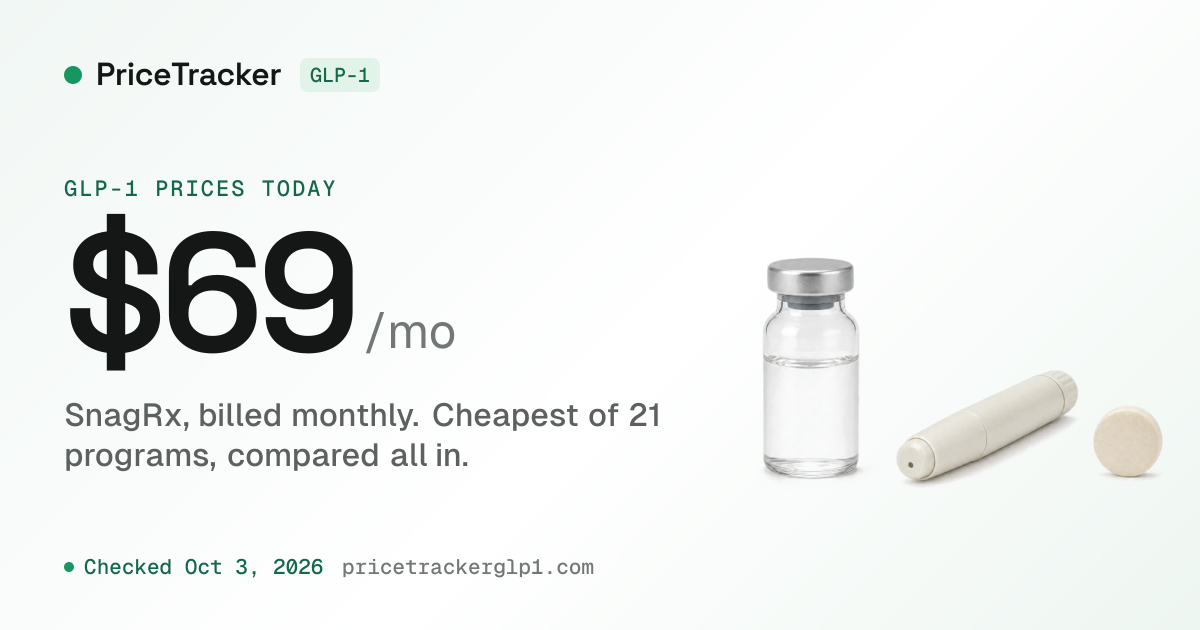
It tracks 21 US telehealth programs. As of October 2026, the cheapest is SnagRx at $69/month billed monthly, with Embody matching that price on a 12-month prepay of $828 upfront.
Can I download the price data for research or journalism?+
Yes. The full dataset is available as a CSV file under a CC BY 4.0 open license, meaning you can use and republish it with attribution.
Does it cover brand-name GLP-1s like Wegovy or Zepbound bought at a retail pharmacy?+
Partially. The site lists manufacturer cash prices for Wegovy ($208/month), Zepbound ($358/month), and Foundayo ($208/month), but the main ranked board focuses on telehealth programs. Retail pharmacy pricing through insurance is handled via the coverage checker tools rather than a ranked comparison.
Is the clinical information on the site reviewed by a doctor?+
The site states that clinical facts are reviewed by Dr. A. Goher, MD. The site is explicit that it tracks prices and public records and is not a substitute for clinical care.
More AI Business Tools
See all categoriesGet your tool listed on 300+ directories.
One listing here is a strong start. But the founders who get discovered everywhere are listed everywhere. Our sister site, Free AI Directories, submits your tool to 300+ AI directories for you, every single one by hand, by a real person.
It is a one-time payment of $49, no subscription, and you can follow along as the submissions land. Prefer the slow route? The same site keeps a free list of 450+ directories you can work through yourself.
Get my tool listed on 300+ directoriesOne-time payment, no subscription · 100% human submissions · Free list of 450+ directories included.