AI Aggregator Platform Guide: What It Is and How to Choose
Learn what an AI aggregator platform is, how it routes and organizes AI tools, and what to check before choosing one.
A draft is due at 4, the hero image still looks wrong, and the meeting recording needs a transcript. Each job points to a different app, a different login, and a pricing page you only half remember. Opening one more tab rarely makes the shortlist clearer.
That is the moment an AI aggregator platform tries to own. Some are catalogs that help you find options. Others are gateways that send one prompt to a provider and meter the response. Treat the choice as routing plus data handling: where the request goes, the cost per finished task, and which vendor keeps the text you paste in.
Rankings can build a shortlist. They cannot prove a tool will transcribe your meeting within budget or honor your data terms.
Table of Contents
- What an AI Aggregator Platform Is
- Why the AI Tool Market Needs Aggregators
- How a Request Moves Through an Aggregator
- Three Kinds of Aggregators and Who Each Suits
- How to Read Scores, Reviews and Rankings
- Common Misconceptions About AI Aggregators
- What to Check and How to Decide
What an AI Aggregator Platform Is
A flight search page shows fares from many airlines, so you don't open every carrier site. An AI aggregator platform does that job for AI software. It sits between you and the products. It organizes access. It does not replace the price, the data terms, or the limits each vendor sets.
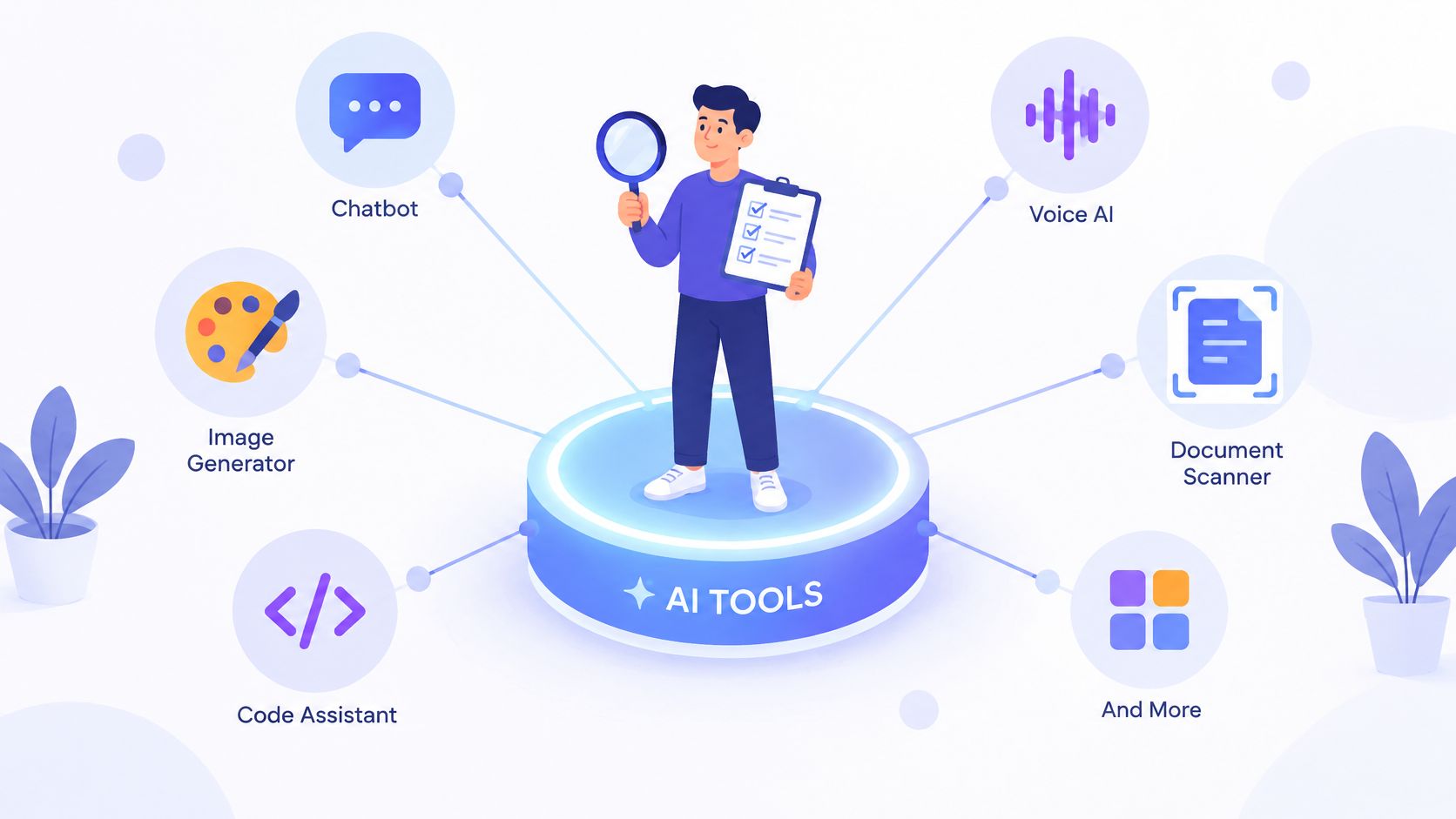
These platforms usually do three jobs.
- Gather. They pull tools or models into one catalog.
- Sort. They group entries by task, such as writing, design, coding, or automation.
- Route. Some take a single request and send it to an available provider, instead of making you pick an endpoint first.
Say a small content team needs a drafting model, an image generator, and a transcription tool. Without a shared front door, that team keeps three logins, three invoices, and three settings pages. With one aggregator, access is managed in one place. Each tool still bills on its own terms, and each one still decides what it does with pasted text.
Three products share the name
People mix up a list of links with software that calls a model. They fail in different ways, so they need different checks.
A model gateway is one endpoint that reaches many model providers. A multi-model chat workspace is one screen where you send the same prompt to several models. A tool directory is a searchable catalog of AI software. Many products blend those roles. Name the primary one before you compare scores or prices.
Why the AI Tool Market Needs Aggregators
The Stanford University 2025 AI Index Report records how far AI use has moved into ordinary organizations. In 2024, 78% of surveyed organizations reported using AI, up from 55% in 2023. That shift is not one general chatbot. It is a pile of specialized products for writing, image generation, video editing, audio cleanup, coding help, research, sales outreach, and autonomous agents. Each product has its own pricing page, login, and terms.
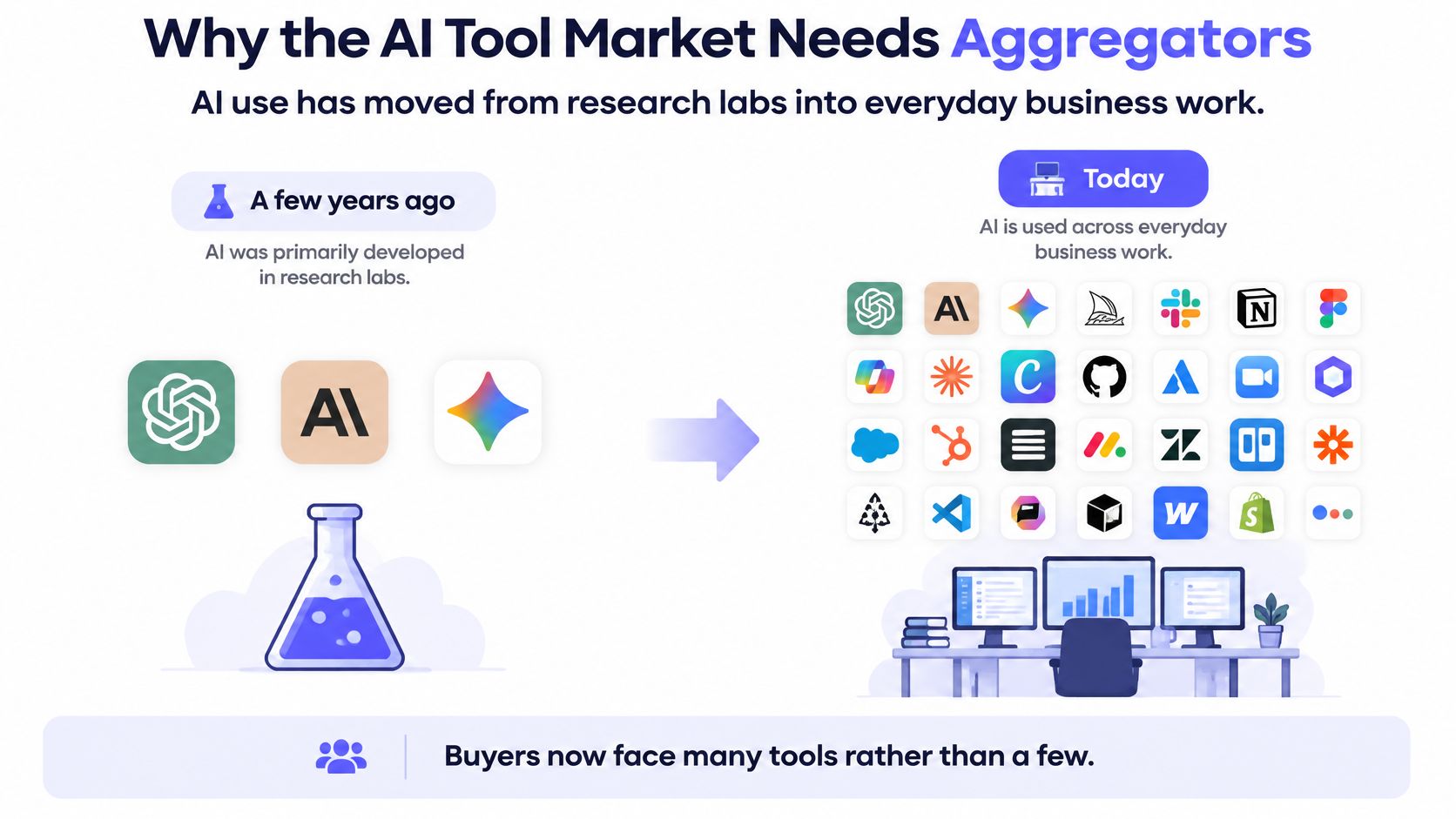
A marketing manager can open a dozen tabs, trust an old roundup, and still not know which tool fits one job. The search cost shows up in three forms.
- Time. Hours go to feature lists that don't match the task.
- Duplicate subscriptions. Two tools get bought because nobody mapped which job each one covers.
- The wrong job. A video editor gets purchased when the team needed a transcript and a short rewrite.
Eurostat reported that in 2025, 19.95% of enterprises in the European Union with at least 10 employees used AI technologies. Plenty of organizations are still picking a first tool, not replacing a mature stack.
Read the samples apart. The Stanford figure covers surveyed organizations. The Eurostat figure covers EU enterprises with at least 10 employees. They are not the same group, so don't treat one as a check on the other.
An aggregator cuts that search by sorting options by task and capability, and by making a side by side look possible before a purchase or a trial. It doesn't decide for you. It narrows the field so your own test can start sooner.
How a Request Moves Through an Aggregator
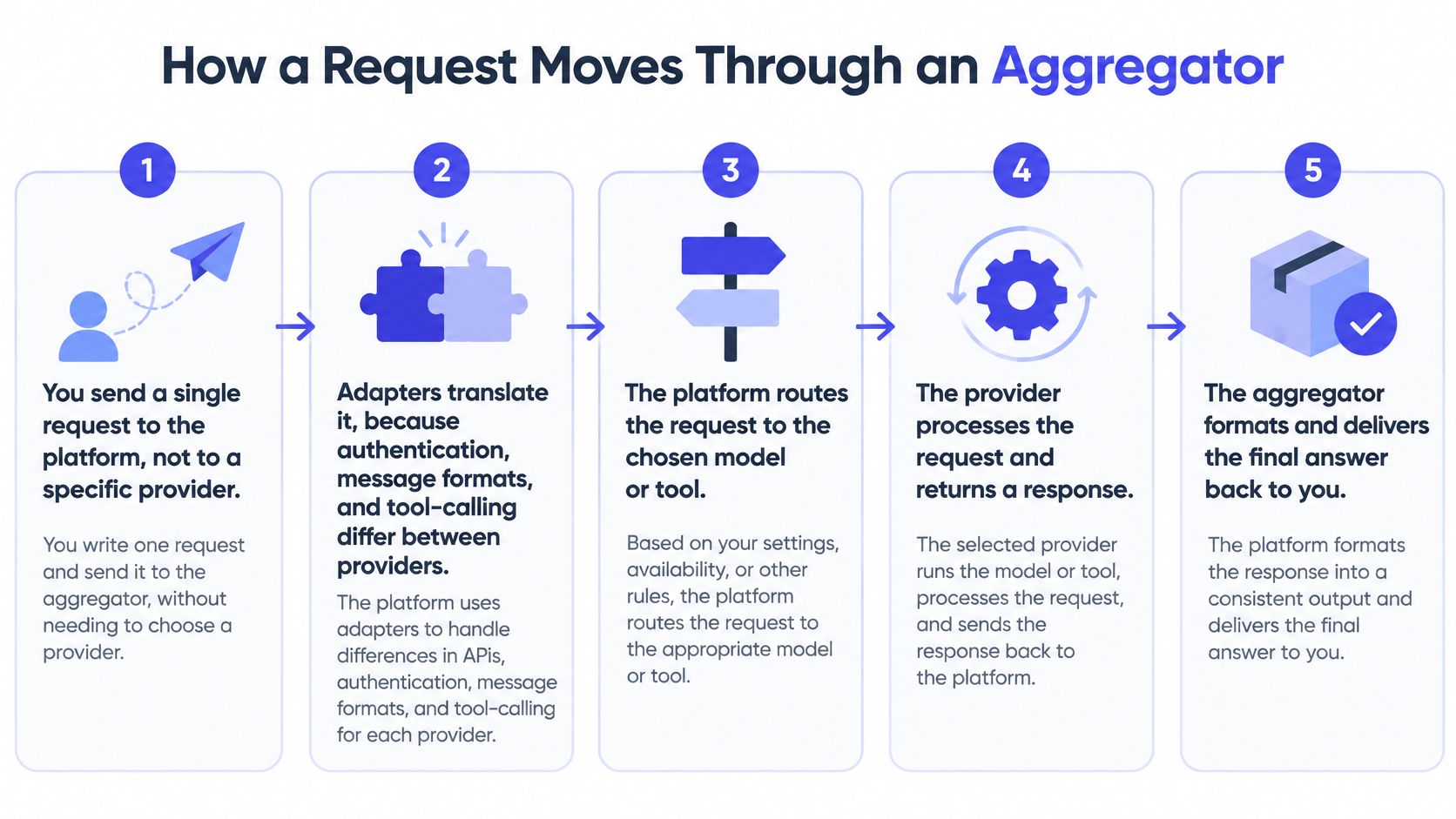
A gateway doesn't show you ten model homepages. It takes one request and decides where that request goes. Watch one prompt move through five stages.
- You send a single request. It goes to the platform, not to a named provider.
- Adapters translate it. Authentication, message formats, tool-calling schemas, and context limits differ by provider. The platform has to reconcile those differences before two answers are comparable. Streaming behavior, safety responses, and usage accounting get normalized in the same pass.
- The router scores each eligible provider. One documented setup in the LLM Gateway routing documentation assigns relative weights of 0.6 to token price, 0.5 to uptime, 0.3 to generation throughput, and 0.075 to streaming latency.
- Health checks and circuit breakers drop a failing provider. Retry budgets cap how many times the same request is sent again.
- The platform returns the answer and records token usage so the bill matches what was spent.
A higher token price can still win
Those weights belong to one configuration. They are not a universal standard. Another platform can weight uptime more heavily, or use separate targets for live chat and overnight batch jobs.
A provider that costs a bit more per token can still take the request. If it avoids retries and queues, the person waiting sees the answer sooner, and you don't pay twice for a failed call. Ask how the platform scores price, uptime, throughput, and latency. A rate card alone won't tell you.
The router changes the bill as much as the token rate does.
Three Kinds of Aggregators and Who Each Suits
| Type | What it gives you | Best for | Watch for |
|---|---|---|---|
| Model gateway | One endpoint for many model providers | Developers and automation builders | Adapter gaps, data handling terms, and per-token pricing |
| Multi-model chat workspace | One interface to send the same prompt to several models | Writers, researchers, and marketers comparing outputs | Included models, usage limits, and plan terms that vary |
| Tool directory | Categorized listings with comparisons and reviews | Business owners and buyers choosing software | Scores that reflect stated criteria, not guaranteed results |
A model gateway suits people who want to switch models without rewriting the call. Judge it on routing, uptime, and data handling, not on how pretty the marketing site looks.
A multi-model chat workspace suits people who want to see several answers to one prompt. Included models and usage limits change by plan. Confirm both on the vendor's site, and note the date you checked. Judge the workspace on model coverage and whether the screen fits how you write or research.
A tool directory is a catalog sorted by task. Judge it on how reviews are made, not on a badge that says "best." AI Tool Seekers is a hand-verified AI tools directory that organizes listings by task, including writing, design, coding, automation, and research. You can use the AI tool finder to narrow that catalog to a job before you open vendor sites. If you want the wider method for building a shortlist, this guide on how to find the right AI tools walks through comparing options and even standing up your own hub.
Many platforms mix these roles. A chat app may also route models, and a directory may link out to both. Name the primary role first. Then apply the check that belongs to that role.
How to Read Scores, Reviews and Rankings
Three signals get mashed into one star. They answer different questions.
An editorial score is an assessor's judgment under stated criteria. A benchmark measures specific tasks under test conditions. A user review average reflects who chose to respond, and why. None of them is a promise that the tool will finish your work.
ToolChase publishes one concrete editorial model. Its score uses eight weighted parameters: core product quality at 25 percent, ease of use at 15 percent, value for money at 15 percent, feature depth at 15 percent, reliability at 10 percent, integrations at 8 percent, market trust at 7 percent, and support or documentation at 5 percent. The site says scores are not crowdsourced averages. Pricing is checked against official websites before publication, with monthly rechecks.
Put the weights next to your job
If integrations matter more to you than core product quality, don't let the 25 percent factor drown the 8 percent one. Read the weights, then re-rank the tools in your head. A staffing team doing the same kind of reading can use a staffing agency software comparison guide to see how feature lists, fit, and price get separated before anyone treats a single score as the decision.
On any directory, check four things. Does it state its criteria? How often are scores updated? Is pricing checked against vendor sites? Does payment change placement?
A team member at AI Tool Seekers reviews each submission by hand, checking the features, the pricing, and what real users report. The directory has 0 pay-to-rank slots. Read how verification works, then ask those same questions of any directory you already use.
Common Misconceptions About AI Aggregators
The cheapest option always wins. Routing can cut spend. An evaluated LightGBM-based router preserved task quality while reducing realized cost by approximately 90% on PinchBench and 43% on DRACO compared with a fixed strong-model baseline. Savings still depend on the workload and on quality checks. Ensemble routing can raise quality further, and it adds wall-clock time because several models run.
More models means better results. Breadth helps only when the right model is on the list and has been checked on your task. A long menu with no evaluation is just a longer menu.
An aggregator removes outage risk. It reduces dependence on one provider. The platform still relies on each provider's health and on its own adapters. A broken adapter blocks every model behind it.
A listing is an endorsement. A listing is a review under stated criteria. Being listed on AI Tool Seekers does not guarantee traffic, rankings, citations by AI systems, sales, or any other outcome. It is not a promise about your workflow.
A free trial is a free plan. A trial ends. Check ongoing pricing on the vendor's site, and write down the date you checked. Call it a trial, not a permanent free tier, unless the vendor's page says the free offer doesn't expire.
Each of these assumptions hides a missing test. Ten tasks from your own work replace the assumption with a result you can see.
What to Check and How to Decide
Use eight checks before you subscribe, connect an API, or paste client text into a new workspace.
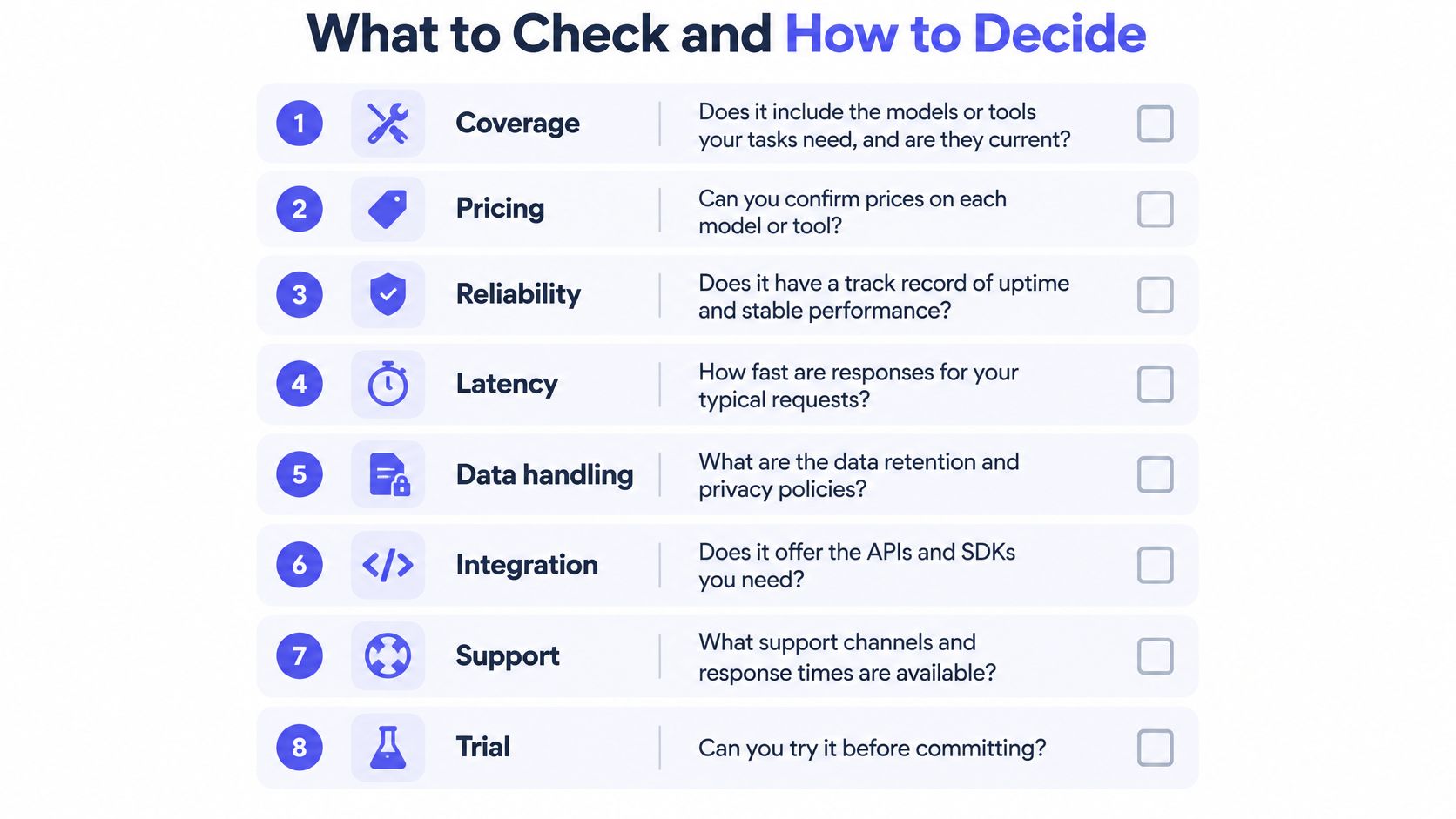
- Coverage. Does it include the models or tools your tasks need, and are those entries current?
- Pricing. Can you confirm prices on each vendor's own site? If a page mentions a price or a free offer, treat that page as the source and recheck it. Don't rely on a copied table.
- Data handling. Does the provider train on your inputs? Where is data processed and stored? Which retention, deletion, and audit log options exist?
- Reliability. What happens when one provider fails? Is there failover, and is there a status history you can read?
- Quality on your work. Do results hold up on your documents, not on a generic demo?
- Speed. Is latency acceptable for live chat? Is batch processing available when the work can wait?
- Cost per finished task. Add subscription or token spend and the time spent on rework. Divide by completed tasks. A cheap call that needs a full rewrite is not cheap.
- Exit path. Can you export prompts, logs, and settings if you leave?
Four moves after the checklist
- Pick the kind you need: gateway, chat workspace, or directory.
- Shortlist three candidates in that category only.
- Verify pricing and data terms on each vendor's site, and note the date.
- Run ten real tasks from your work through every candidate. Record success, time, and cost. Keep the best cost per finished task that still meets your data rules.
AI Tool Seekers offers free tool listings, editorial reviews with an Editor's Score, category and comparison pages, a glossary, and an optional paid Fast Track add-on. Tools can be compared side by side on features, pricing, and Editor's Score. The glossary explains RAG, fine-tuning, embeddings, AI agents, and 17 more AI terms, each tied to the tools that use it. Build the shortlist from those comparison pages. A hiring team can apply the same shortlist habit when they compare AI mock interview tools: match the product to the task, then trial it on real questions.
Privacy needs change by region and sector. Directory content is not legal advice. Your own ten-task run is the decision.
AI Tool Seekers keeps a hand-verified directory so you can compare writing, design, coding, and automation tools by task instead of trusting a single ranking. Reviews carry an Editor's Score, and comparison pages set features and pricing next to that score. Start with the category that matches the job you need to finish at AI Tool Seekers.