Storytelling Artificial Intelligence: Uses and Limits
Learn how storytelling artificial intelligence drafts plots, characters and dialogue, where it falls short, and how to check its output before you publish.
A chapter has stalled. The document is open, the next scene is blank, and an AI model can supply a page of possible openings almost immediately. The harder question is whether any opening belongs in this particular story. A useful result starts with the writer's decisions, not the model's fluency.
Table of Contents
- What Storytelling Artificial Intelligence Actually Does
- Core Techniques for Drafting, Planning and Revising Stories
- How to Build a Story With AI in Stages
- Where Storytelling AI Shows Up in Practice
- Limits Writers Notice and How to Judge AI Story Output
- How to Disclose AI Help in a Story
- Test a Small Storytelling Workflow Before You Commit
What Storytelling Artificial Intelligence Actually Does
Storytelling artificial intelligence is software that generates, plans, or revises narrative text from a prompt. Its tasks can include dialogue, character descriptions, plot outlines, and interactive scenes. A writer supplies direction, and the system produces a possible continuation.
The model works like a fast draft partner that has read a very large amount of text. It predicts plausible next words and familiar story shapes. It doesn't have lived experience or an intention aimed at a specific reader.
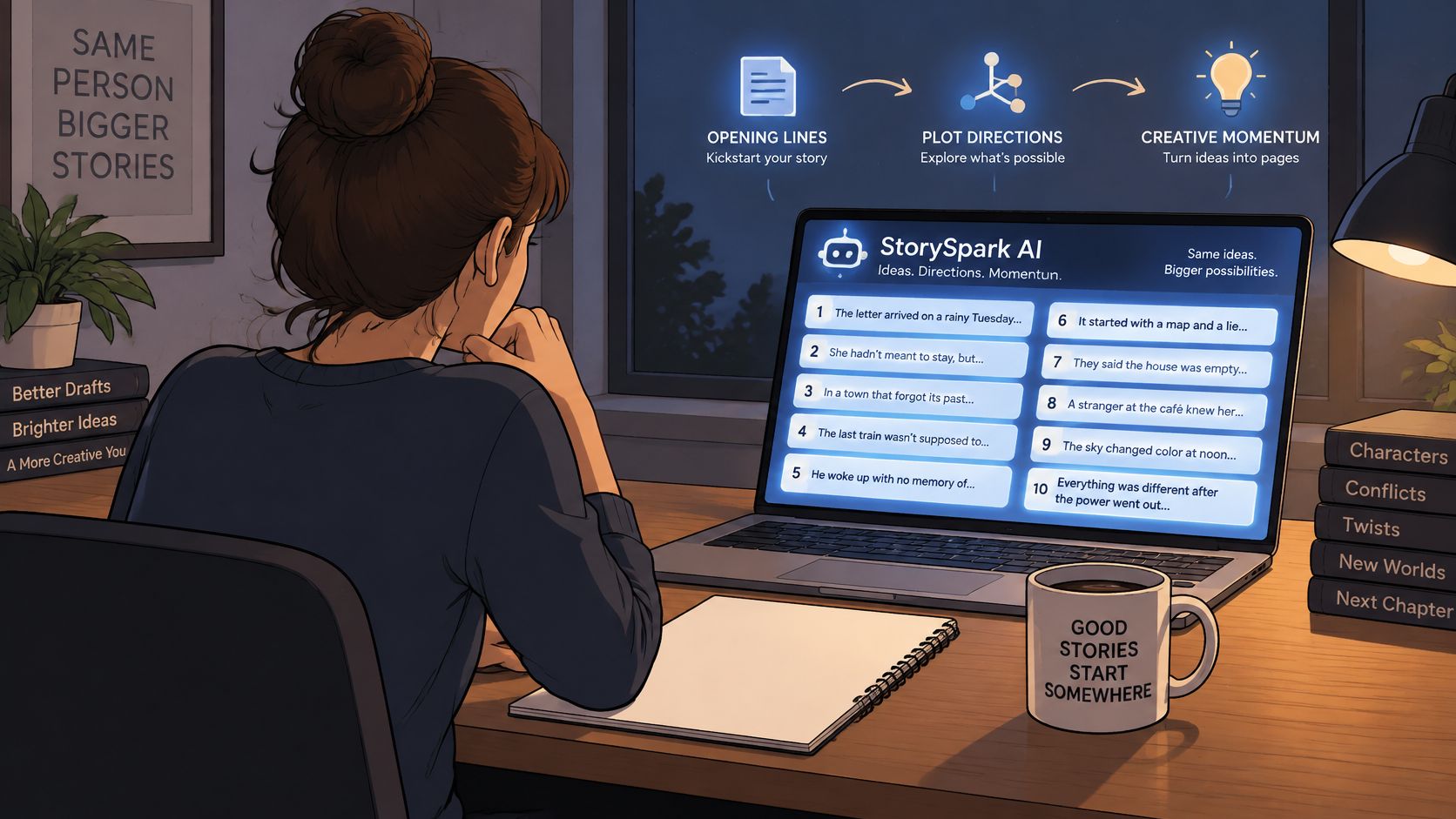
The role matters more than the blank page
Consider a mystery about a locksmith who discovers that a missing neighbor changed every lock before disappearing. A vague request for an exciting mystery leaves the model to choose the audience, motives, setting, and resolution. A detailed writer's brief gives it less room to make choices that clash with the intended story.
The writer can assign different jobs:
- Drafter: Produces prose for the locksmith's arrival at the empty apartment.
- Planner: Suggests clues, obstacles, character goals, and possible turning points.
- Editor: Examines an existing scene for unclear action or rewrites a passage within stated boundaries.
These roles shouldn't be confused. A model asked to edit may introduce new facts unless the writer restricts the task. A planner may propose an appealing twist that contradicts the intended ending.
Practical rule: A clear assignment makes the output easier to judge. A broad request makes the model responsible for decisions the writer may not want it to make.
The output is only as strong as the brief that directs it, though a strong brief still can't guarantee quality. The technology isn't a replacement for a story idea, doesn't automatically produce original work, and doesn't verify factual claims.
For a writer or publisher, the useful questions are practical: which techniques work for the task, where those techniques fit, and how the resulting story should be judged.
Core Techniques for Drafting, Planning and Revising Stories
The task column is the best starting point. The risk and quick check then show what an editor should inspect before accepting the result.
Storytelling AI techniques by task
| Technique | Best Use | Main Risk | Check Before Use |
|---|---|---|---|
| Scene drafting | Turning one beat into prose | Generic phrasing and repeated sentence rhythm | Read the first and last lines aloud and rewrite them |
| Plot outlining | Mapping beats and turning points | Predictable structure | Check that each beat has a cause and a cost |
| Character sheets | Goals, fears, and speech patterns | Flat motives | Ask what the character wants that the story blocks |
| Continuity tracking | Keeping names, timelines, and objects consistent | Drift across long text | Keep a fact list and check each chapter against it |
| Dialogue variation | Testing distinct character voices | Characters who sound alike | Give each character one sentence habit |
| Worldbuilding | Rules, places, and history | Overexplained lore | Keep only the details the plot uses |
| Interactive roleplay | Branching choices and player responses | Lost track of earlier choices | Summarize the story state every few turns |
| Revision pass | Tightening prose and adjusting tone | Erasing the author's voice | Keep the author's own sentences where possible |
Choosing a technique by the actual problem
A slow scene doesn't necessarily need a rewrite. It may need a character goal, a stronger obstacle, or less background information. Selecting the technique before identifying the problem can produce polished sentences around an unchanged weakness.
For the locksmith mystery, a character sheet should explain why the protagonist enters the apartment despite the risk. A list of favorite foods and childhood memories won't solve that problem. Likewise, worldbuilding should establish the building's access rules if those rules affect the mystery, not supply an unrelated neighborhood history.
Controlled generation offers a useful way to frame these assignments. A controllable text generation benchmark evaluates instruction adherence alongside generation quality, supporting a distinction between attractive prose and prose that meets its constraints.
Planning first, then working locally
Planning should precede drafting. A writer can inspect an outline for a missing motive without being distracted by atmospheric description. Once the structure works, scene-level requests make each result manageable enough to review.
Drafting should proceed scene by scene. Each assignment needs a starting situation, a character goal, an obstacle, and a changed situation at the end. That's more useful than asking for additional length without specifying what must happen.
A separate language-editing pass can follow structural revision. The Grammarly review provides a reference for readers considering that kind of assistance. The editorial boundary should remain explicit: grammar suggestions shouldn't become permission to replace distinctive narration or dialogue.
How to Build a Story With AI in Stages
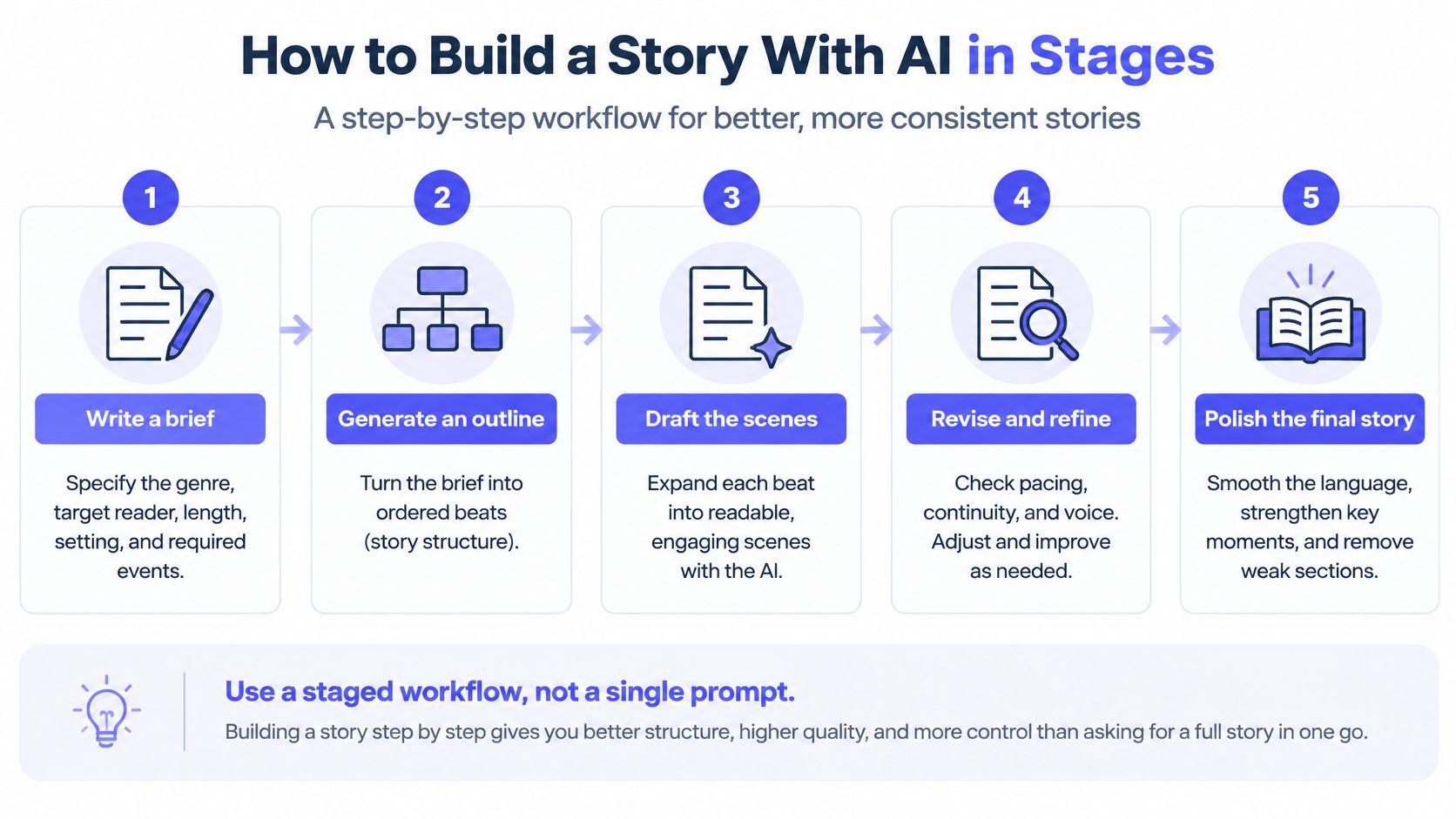
A staged workflow separates decisions that otherwise arrive mixed together. Asking for a complete story at once leaves the writer sorting out plot, motivation, continuity, and style inside the same draft.
A narrative-planning benchmark uses Answer Set Programming to validate causal soundness, character intentionality, and dramatic conflict. Its experiments found that GPT-4-class models could produce causally sound stories at small scale, while character-goal planning and sustained conflict remained difficult.
The workflow below separates planning, prose generation, and review.
From assignment to an approved plan
Write the brief. The writer names the genre, target reader, intended length, setting, required events, and desired ending. The reason is straightforward: the model can't reliably satisfy requirements that remain unstated.
Request a structured plan. The plan should identify characters, goals, obstacles, causal dependencies, and escalating conflict rather than merely listing events. This makes it possible to see whether each development changes what the protagonist can do next.
Inspect the logic before drafting. The writer checks for missing causes, unmet goals, and actions without motives, then revises the plan. Repairing an outline avoids having to reconstruct finished scenes around a late structural correction.
For example, the locksmith's plan might require a choice between protecting a client's privacy and reporting evidence of danger. The outline must establish how the locksmith recognizes that danger. Otherwise, the decisive choice depends on information the character hasn't earned.
From approved plan to edited prose
Draft a scene with its relevant context. Each request includes the approved plan, the current story state, and the earlier passage needed for the scene. Additional text alone doesn't guarantee global consistency, so the writer specifies what changes and what must remain fixed.
Run a continuity check. The reviewer compares names, dates, objects, access rules, and character knowledge against a maintained fact list. This catches problems such as a witness referring to a discovery that hasn't yet been shared.
Revise in the author's voice. The author cuts repeated phrasing, restores intentional sentence patterns, and removes explanations that weaken the scene. The reason is editorial ownership: acceptable plot mechanics don't make the generated voice appropriate for publication.
The ChatGPT review can help readers investigate a conversational interface for these assignments. The process should remain portable, with the brief and story records stored separately from any particular chat.
A successful run ends with a plan that has no unexplained gaps, scenes that advance character goals, and a draft that meets the assignment.
For interactive stories, the record also needs to capture player choices and unresolved consequences. A scene that works locally can still fail the larger narrative if it cancels an earlier decision.
Where Storytelling AI Shows Up in Practice
Fiction is a substantial use of conversational AI. An analysis of the WildChat dataset found that over one-third of more than 500,000 anonymized, English-language conversations involved fiction generation, including stories, scripts, roleplay, fanfiction, and worldbuilding. That measures conversations containing fiction, not the share of all people using AI or the number of commercial projects.
The practical setting changes both the assignment and the person responsible for approval.
Stories for readers, players, and production teams
- Fiction drafting: Novelists and short-story writers can request alternate scenes, transitions, or supporting-character sketches for their readers. The author approves the creative choices, and the publishing editor approves material moving toward publication.
- Interactive games and roleplay: Players encounter branching dialogue and non-player characters. A narrative designer approves character behavior and world rules, while a game producer determines what can ship.
- Screenplay development: Screenwriters can explore loglines, beat sheets, and character backstories for collaborators and producers. The screenwriter owns the story decisions, with the development team approving the version used in production.
In these settings, the central question is whether the generated material serves the intended experience. A surprising exchange can work in improvisational roleplay but contradict a tightly plotted screenplay.
Stories with teaching or commercial obligations
Educational stories serve learners. A teacher might commission a reading passage built around a classroom topic, then review vocabulary, accuracy, age suitability, and the implied lesson before students encounter it.
Brand narratives serve prospective customers. A marketing writer might develop campaign concepts or a customer-story structure, but an editor and the responsible business owner must approve factual claims. Invented testimonials don't become acceptable because they read like stories.
Worldbuilding drafts serve game studios and publishing teams. Writers can explore place names, factions, and histories, while a lead designer or editor approves additions to the established setting. Task-based AI writing tool listings offer a starting point for narrowing that kind of search.
Some projects also need visual adaptation. ClipNova provides an option to make cartoon videos with AI, which is relevant when a reviewed story is being considered for animation. The production owner still needs to approve how the adaptation represents the script.
The same drafting technique can therefore carry very different stakes. A private fictional exchange and a classroom resource shouldn't share the same approval process.
Limits Writers Notice and How to Judge AI Story Output
Fluent prose is weak evidence of an imaginative story. A 2024 study in Humanities and Social Sciences Communications compared 330 stories, comprising 250 human-written stories from June 2019 and 80 stories generated by GPT-3.5 and GPT-4 in March 2023. The AI stories were more progressive in their treatment of gender roles and sexuality, but generally less imaginative and less varied in prose.
The researchers also found substantial thematic similarity, particularly among GPT-3.5 outputs, and greater racial diversity among characters in the human-written material. In that comparison, 28 of the 80 AI stories, or 35%, followed a Pygmalion pattern involving a male creator and a female creation.
Those findings describe particular models and samples rather than a permanent ranking of human and machine creativity. What they give a working editor is a separation of qualities: social representation, originality, prose variety, and coherence are different things, and a draft can succeed at one while failing at another.
Warning signs beneath readable sentences
A draft can sound confident while skipping the reason a character changes sides. It can preserve a character's name while subtly changing what that character knows. It can also avoid obvious contradictions yet make every expected choice, page after page.
Each failure calls for a different repair, which is why vague feedback wastes revision passes. For the locksmith mystery, an atmospheric description of an empty apartment doesn't explain why the protagonist suspects a staged disappearance. The editor should identify the missing evidence rather than request a more dramatic rewrite of the same paragraph. A more dramatic rewrite would still leave the suspicion unmotivated.
Editorial checkpoint: Every criticism should identify an observable problem in the text, not merely a general feeling that the story sounds artificial.
Rubric for judging storytelling AI output
| Dimension | What to Check | Warning Sign | Test to Run |
|---|---|---|---|
| Coherence | Events follow from earlier events | Scenes that contradict each other | Summarize the plot in five lines and look for gaps |
| Causality | Each turn has a cause and a cost | Events happen with no reason | Ask why each turn happens and what it costs |
| Character intent | Each character has a goal that drives choices | Characters react without wanting anything | Ask what each character wants on the first page |
| Originality | At least one surprising choice | Expected plot and phrasing throughout | Compare the draft with three standard versions of the same premise |
| Consistency | Names, rules, and knowledge stay stable | Names or facts drift between chapters | Check a fact list against each chapter |
| Diversity | Characters, settings, and themes vary across a set of outputs | Repeated plot shapes across drafts | Compare several drafts side by side |
| Reader engagement | A fresh reader keeps going | Reader stops or cannot state the goal | Ask a blinded reader to summarize the story |
The rubric works as an editorial procedure rather than a validated scientific scale. Its value comes from separating problems that need different repairs. A contradiction calls for a factual correction inside the story; weak intent calls for a clearer desire and a meaningful choice in the next brief.
Separating authorship expectations from quality
Experimental research on authorship and story evaluation has examined how labeling a story as AI-authored changes reader judgments, finding that the label reduced perceived creativity, agency, and experience. Authorship framing can therefore shape a reader's verdict independently of what the text does.
A blinded review keeps that influence out of the first reading. The reviewer receives a copy with tool names and generation notes removed, then records textual observations before learning how the draft was made. A disclosed review can follow to examine whether knowledge of AI involvement changes willingness to publish, recommend, or read further.
Two passes, two questions. The first asks whether the story works on the page; the second asks what the authorship label adds to the answer.
Recording a useful editorial decision
Each dimension can receive a consistent rating such as pass, revise, or reject, accompanied by the passage that caused the rating. A note such as “the locksmith knows about the hidden key before finding it” is actionable. “Needs more humanity” isn't.
Revision should target the failed dimension, which is where the brief does its work. If character intent is weak, the next assignment should strengthen the protagonist's reason for acting without changing approved world rules or the ending. A full rewrite may erase successful material and introduce unrelated defects, so the instruction should name the dimension and the constraint, nothing more.
Diversity requires comparison across drafts, not inspection of a single protagonist. The editor should examine who gets agency, whose knowledge matters, and whether different premises keep returning to the same relationship or resolution. A varied list of names alone won't establish thematic breadth.
How to Disclose AI Help in a Story
A writer who used AI only to sort character names and a writer who kept generated paragraphs in the final draft would both count as "AI-assisted," yet readers would not weigh them the same way. Disclosure should describe the work AI performed, and a broad label cannot carry that detail. A 2025 study of writing-related AI use, summarized alongside audience findings in a study of AI disclosure practices, supported a user-driven system recording tools and assistance. Readers often expect authors to say how AI was used, so the record behind the note matters more than the wording of the note itself.
Brainstorming a premise is different from retaining generated paragraphs. A useful disclosure lets readers understand that distinction without requiring a complete production log.
Keeping an assistance record
A reliable disclosure starts during drafting, not at publication. The note written at the end can only describe what the record captured along the way.
- Identify the stages involved. The project record marks brainstorming, planning, drafting, and revising separately, because assistance can change during production.
- Record the tool and task. An entry names the software and states its assignment, such as proposing alternate scene endings.
- Track retained text. The author notes which generated passages remained, which were rewritten, and which were discarded.
- Prepare the reader note. The final statement describes the level of involvement in plain language and matches the actual record.
The record belongs with the manuscript files. An early note saying ideas only becomes inaccurate if a later revision incorporates generated dialogue.
Writing a meaningful reader note
The record supplies the material; the note selects what the reader needs. For an ideas-only project, an appropriate note might state that AI supported brainstorming while the author wrote the narrative. For a mixed project, the note should identify generated drafting and subsequent human revision. The language should describe what happened without implying that every sentence had the same origin.
- Human-written with AI brainstorming: Distinguishes suggestions from retained prose.
- AI-edited: Identifies language assistance and its scope.
- AI-generated or mixed: Makes retained generated text clear.
A detector score cannot reconstruct those production decisions, and a disclosure note does not settle copyright ownership or satisfy every publisher's policy. Submission requirements need separate review, with the assistance record ready to support whatever the publisher asks.
Test a Small Storytelling Workflow Before You Commit
A useful pilot starts with a short scene whose reader, purpose, and ending are already clear. The writer creates a brief, completes the staged process, and keeps the original request beside the edited result.
The pilot should record human effort as well as draft quality. Generation may be quick while continuity repair, fact-checking, and voice restoration take substantial editorial attention. The relevant comparison is the complete workflow, not the time required to produce the first response.
A decision rule for expanding the project
- Scale when the result holds up: The workflow should save effort without lowering coherence, causality, or originality against the project's editorial standard.
- Revise the process when defects repeat: Missing motives call for changes to planning; inconsistent details call for better story records.
- Stop when repair outweighs assistance: A process that repeatedly requires reconstruction isn't ready for a longer manuscript.
AI Tool Seekers is a hand-verified AI tools directory that can help narrow candidates by task. Its listings reflect editorial opinion, aren't professional advice, and don't guarantee results. No tool pays for a higher editorial score or ranking.
Pricing should be checked on each vendor's site before a commitment, since terms can change. A trial should be treated as a trial, not as a free plan.
The pilot's final decision should name the task worth delegating. That might be outline alternatives rather than prose, or continuity questions rather than rewriting. A narrow, dependable use is more valuable than a broad assignment that requires constant repair.
AI Tool Seekers offers an AI readiness checker, an AI tool finder, an AI cost calculator, and an AI visibility checker as four free utilities. Visit AI Tool Seekers to narrow options for a specific storytelling task, then evaluate a small scene against a written brief before committing to a larger project.