iLang
An open, MIT-licensed AI-to-AI communication protocol with 88 verbs, two syntaxes, and a vector-based judgment layer, free to use across
Are you the maker? Claim this listing to keep info, pricing and screenshots current. Verified via your tool's domain email.
iLang is best suited for AI researchers, multi-agent system builders, and developers who need a portable, model-agnostic protocol layer rather than a code-completion assistant. Its judgment layer and cross-model portability are genuinely novel, but the protocol is early-stage and the ecosystem around it is thin compared to established tooling. Developers who want an IDE assistant or an agentic coding workflow should look at Cursor or GitHub Copilot instead.
What is iLang?
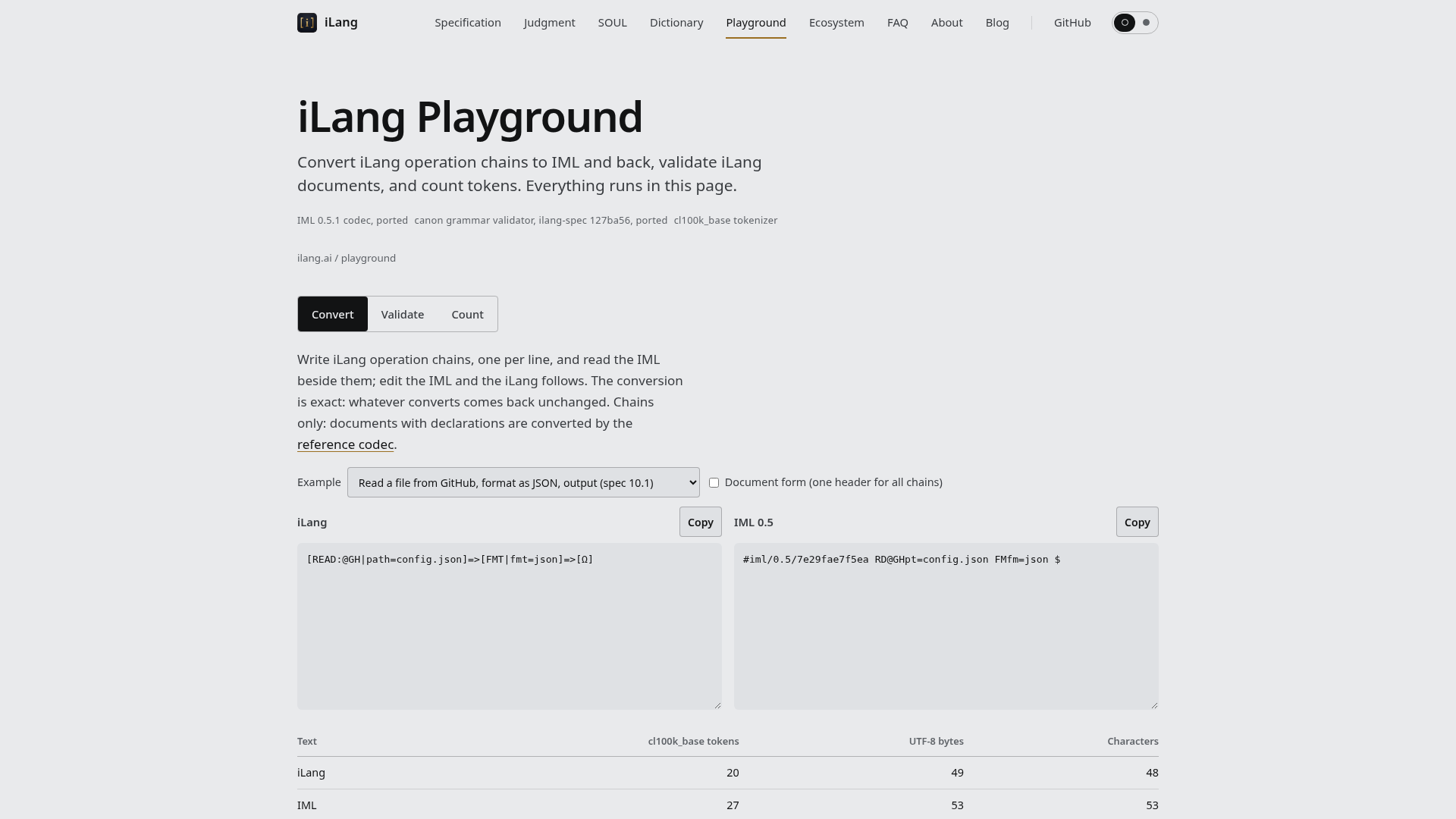
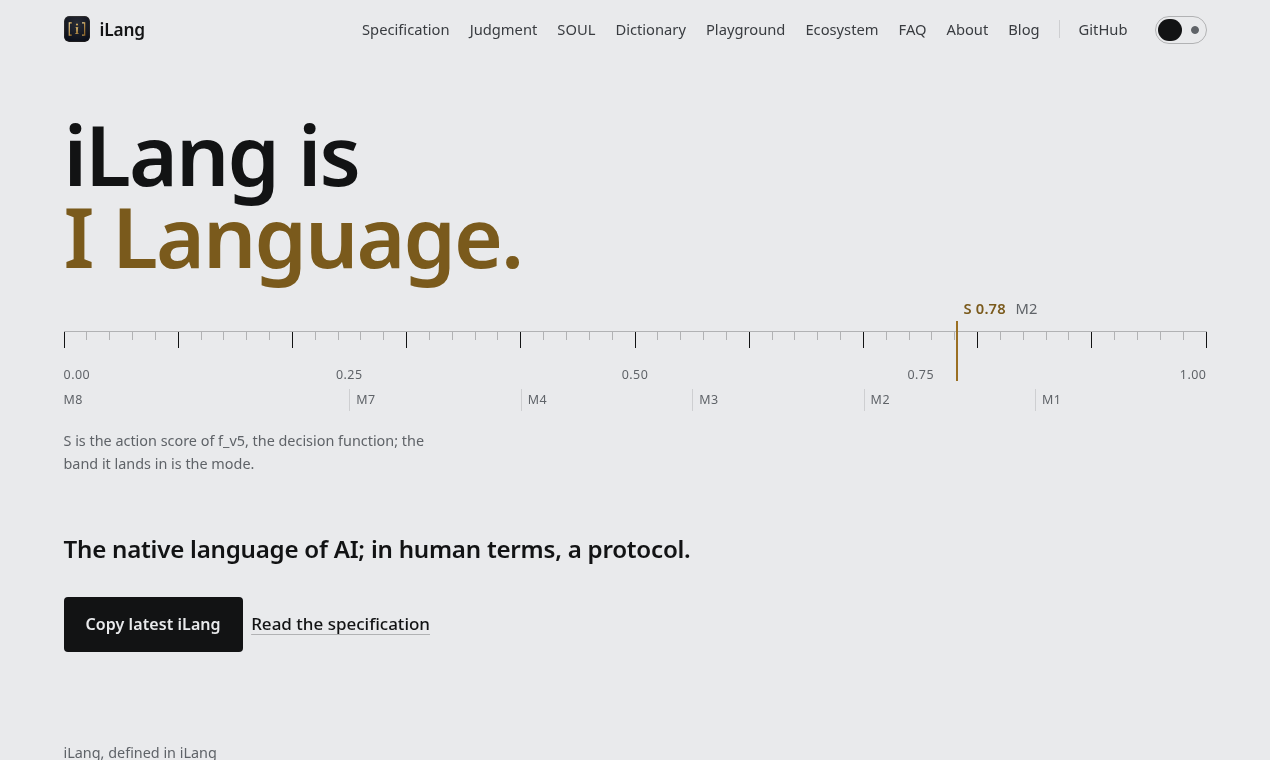
iLang (I Language) is an open AI-native communication protocol built from symbols models already read natively: brackets, pipes, arrows, key-value pairs. It has three layers: communication (88 verbs, two syntaxes), execution (conformance L0-L3) and judgment (an 11-dimension vector). MIT licensed, zero install. It ships as a spec, npm/PyPI packages, a hosted MCP server (https://mcp.ilang.ai/mcp) and a conformance suite.
How we scored iLang
Capability scores 18 because the three-layer protocol (communication, execution, judgment) and the 11-dimension vector judgment layer are genuinely novel and have no equivalent in the directory, but the tool does not write, run, or debug code, which is what most visitors to an AI Coding and Dev Tools directory are looking for. Ease of use scores 14 because the zero-install paste-and-go entry point is real, but the 27,000-token runtime, the absence of any GUI or dashboard, and the need to understand conformance levels and the f_v5 decision function create meaningful friction for anyone outside AI research. Value scores 22 because the protocol, loaders, MCP server, and conformance suite are all free under MIT license, and the only paid item is a $9.99 one-time artifact, making the cost-to-capability ratio strong for its target audience. Delivery scores 8 because the project is early-stage with no documented third-party adoption, no commercial support path, and the ecosystem outside iLang Inc. itself is unverified; the conformance suite covers 45 runs across 7 models but independent validation is absent, and the gap between the protocol's ambitious framing and its current real-world uptake is wide enough to warrant caution.
Pros and cons
What we liked
- Genuinely model-agnostic: the protocol has been conformance-tested across seven major models (ChatGPT, Claude, Gemini, DeepSeek, Kimi, Qwen, GLM) with 45 documented runs, making it portable in a way no single-vendor tool can match.
- The v5.0 judgment layer (11-dimension vector, f_v5 decision function, eight behavioral modes) replaces binary safety rules with continuous assessment, a formally specified capability with no equivalent in the directory competitors.
- Zero-install entry point: pasting the runtime text into any large-context AI is enough to load the protocol, with SHA-256-verified loader packages available for Python 3.9+ and Node when persistence matters.
Where it falls short
- The core runtime is approximately 27,000 tokens, which adds meaningful cost to every non-cached request; production use effectively requires provider-level prompt caching, and teams without that infrastructure will pay a real token tax on every call.
- The project is early-stage and self-described as a protocol rather than a product: there is no GUI, no dashboard, no managed service, and adoption outside the iLang Inc. orbit is not yet documented, making it a bet on a standard that has not yet been widely adopted.
- The $9.99 paid artifact (Source Book 2.9) is a single engineering document rather than a tier with ongoing support or features, so there is no clear upgrade path or commercial support option for teams that need it.
Key features
iLang pricing
The core protocol is free (MIT licensed, zero install). The pricing page lists a $0 tier and a $9.99 offer, which appears to correspond to a specific artifact (the Source Book 2.9 engineering document) rather than a recurring subscription. No traditional SaaS subscription tiers were found.
| Plan | Price | Who it is for |
|---|---|---|
| Protocol (Free) | $0 | Full MIT-licensed protocol specification, Python and npm loaders, hosted MCP server, SOUL 2.0 artifact, conformance suite, and GitHub access. No usage limits on the protocol itself. |
| Source Book 2.9 | $9.99 | A single engineering reference document described as the engineering book every engineering book is anchored to; intended for use in an agent app with a DeepSeek key. One-time purchase, not a subscription. |
Pricing reflects what we saw at time of review (2026-11). Always confirm current pricing on the tool's own site.
Who should use iLang?
AI researchers and multi-agent system builders are the clearest fit. If you are orchestrating agents across different model providers and need a shared grammar for intent, authority, and completion conditions, iLang gives you a formal vocabulary to work with rather than ad-hoc prompt conventions. Developers building agent pipelines with Python or Node who want persistent, verifiable protocol loading will find the loader packages genuinely useful.
Developers who want an in-editor coding assistant, autocomplete, or an agentic tool that writes and runs code for them should look elsewhere. Cursor is the better pick if you want an AI-first editor that understands your entire codebase. GitHub Copilot fits if you want autocomplete and agentic workflows inside VS Code or JetBrains without switching editors. iLang does not write code for you; it defines how AIs talk to each other while doing so.
Skip it if: Developers wanting an IDE coding assistant or autocomplete tool
iLang alternatives
Frequently asked questions
Do I need to learn iLang syntax to use it?+
No. The protocol is designed to be loaded by the AI, not memorized by the user. You paste the runtime into your AI's context (or use the loader package) and continue writing in plain language.
How much does iLang cost?+
The protocol itself is free and MIT licensed. The only paid item listed is the Source Book 2.9 artifact at $9.99, a one-time purchase. There is no subscription or usage fee for the protocol, loaders, or MCP server.
How large is the iLang runtime and does it affect my API costs?+
The core runtime is approximately 27,000 tokens. Without provider-level prompt caching enabled, this adds to the cost of every API call. The Python loader caches a verified copy locally to avoid re-fetching, but the token cost per request remains unless your provider supports prompt caching.
Which AI models support iLang?+
The project reports conformance testing across seven models: ChatGPT, Claude, Gemini, DeepSeek, Kimi, Qwen, and GLM, with 45 documented runs. Any model that accepts enough context to load the runtime can use it.
What is the difference between the two syntaxes?+
iLang offers a human-readable syntax using brackets, pipes, and arrows, and IML 0.5, a compact machine form. Both carry the same semantic content; IML 0.5 is intended for AI-to-AI message passing where token efficiency matters.
Is there a way to load iLang automatically without pasting it every session?+
Yes. The Python loader (pip install ilang-protocol) or npm package wraps your model calls and prepends the runtime automatically. Alternatively, the MCP server at mcp.ilang.ai can be added as a connector in Claude or Cursor so it loads once per configuration.
More AI Coding & Dev Tools
See all categoriesGet your tool listed on 300+ directories.
One listing here is a strong start. But the founders who get discovered everywhere are listed everywhere. Our sister site, Free AI Directories, submits your tool to 300+ AI directories for you, every single one by hand, by a real person.
It is a one-time payment of $49, no subscription, and you can follow along as the submissions land. Prefer the slow route? The same site keeps a free list of 450+ directories you can work through yourself.
Get my tool listed on 300+ directoriesOne-time payment, no subscription · 100% human submissions · Free list of 450+ directories included.