
OpenLinker
A hosted and open-source platform for connecting, calling, and coordinating AI agents across HTTP, MCP, and A2A protocols.
Are you the maker? Claim this listing to keep info, pricing and screenshots current. Verified via your tool's domain email.
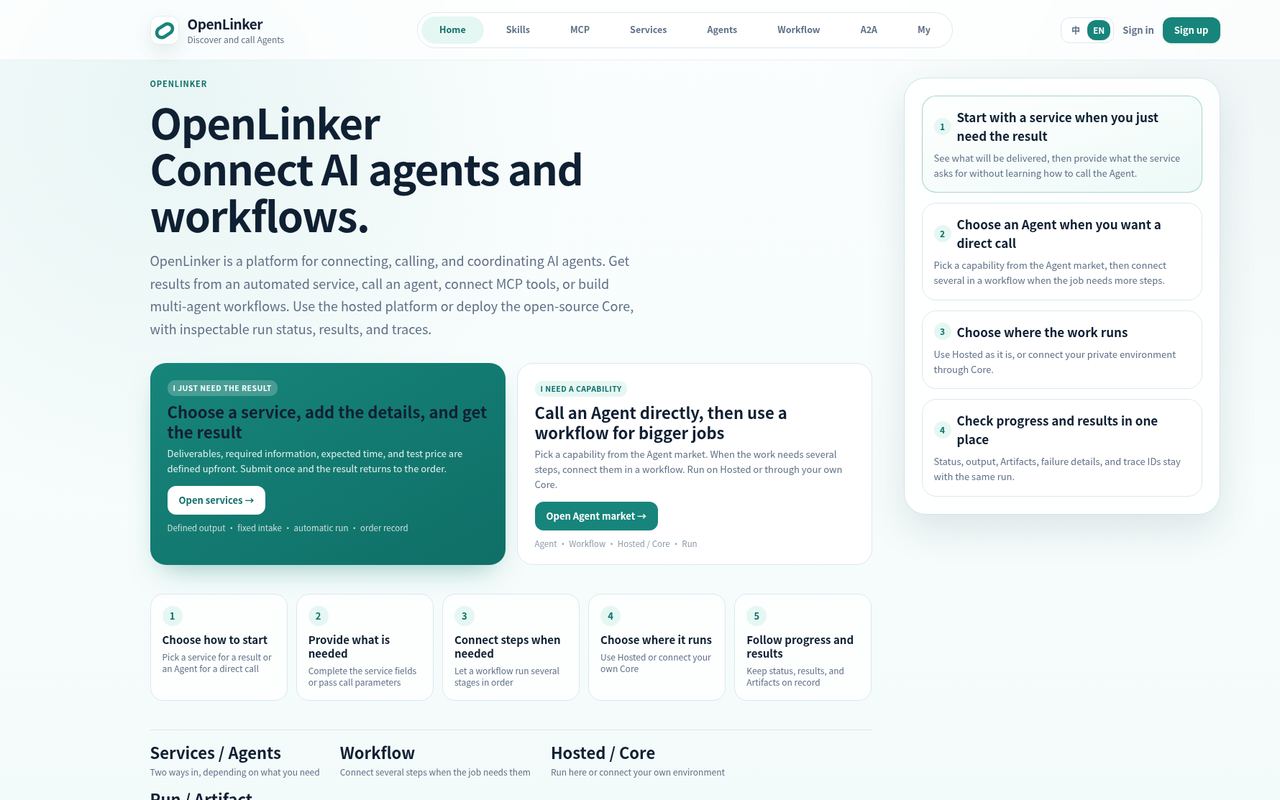
OpenLinker is best suited to developers who want a single place to discover, call, and chain AI agents using open protocols, without paying per-call fees while the platform is in its current test phase. Its A2A and MCP support is genuinely differentiated, but the platform is early-stage: service pricing is described as 'test pricing' with no real transactions enabled, which makes it hard to evaluate long-term cost or reliability. Teams that need production-grade, auditable automation today should look at TRam Studio instead.
What is OpenLinker?
OpenLinker connects, calls and coordinates AI agents. Order a service for a result, call an agent from the market, connect MCP tools, or chain steps into workflows. It brings HTTP, MCP and A2A together in one place, with Go, TypeScript and Python SDKs. Teams can use the hosted platform or self-host the Apache-2.0 open-source Core, and every run is traceable step by step.
How we scored OpenLinker
Capability scores 16 because the multi-protocol support (HTTP, MCP, A2A) and the hosted-plus-self-hosted Core architecture are genuinely differentiated, but the agent marketplace is in test mode with no real deliverable services, which means the core promise of 'order a service and get a result' cannot actually be fulfilled today. Ease of use scores 16 because the platform's conceptual model is clear and the SDK coverage across Go, TypeScript, and Python is solid, but there is no documentation quality signal, no onboarding evidence, and no user feedback to draw on. Value scores 18 because the Apache 2.0 license with no seat limits and no per-call fees is genuinely generous, and the current zero-cost access is real; the score is not higher because the value of free access to a marketplace where no transactions work is limited. Delivery scores 8 because the platform's own pricing page states that no payments are processed, no sales are implied, agent prices are reference information only, and paid plans are not enabled. This is not a minor caveat; it means the platform's central commercial function does not yet deliver what it describes. Combined with zero third-party coverage and no user sentiment found, delivery cannot score higher.
Pros and cons
What we liked
- Supports HTTP, MCP, and A2A protocols in one platform, which is rare among agent coordination tools at this stage of the ecosystem.
- Apache 2.0 open-source Core means teams can self-host with no license fees, no seat limits, and no features gated behind a paid tier.
- Every agent run produces an inspectable trace of status, results, and artifacts, giving developers a concrete debugging surface for multi-step workflows.
Where it falls short
- The entire payment and plan system is explicitly disabled: no real transactions occur, agent market prices are labeled 'reference information only,' and no paid tiers exist yet. This makes it impossible to evaluate the platform's real cost structure or commercial viability before committing to it.
- As an early-stage platform with no active commercial layer, there is no documented SLA, no published uptime history, and no support tier to fall back on if the hosted service degrades.
- The agent marketplace is in test mode, meaning listed agents and their prices do not represent real, deliverable services. A developer cannot yet rely on the market to source production agent capabilities.
Key features
OpenLinker pricing
Currently free across all usage. The pricing page states that calls, service orders, and agent interactions incur no charges at present. Seller-listed prices on the agent market are described as reference information only, and no wallet or payment system is active. Paid plans and settlement are listed as 'not enabled.' This is explicitly a test-phase pricing model; real paid tiers have not been announced.
| Plan | Price | Who it is for |
|---|---|---|
| Current (Test Phase) | Free | Full access to service orders, agent market browsing, private task creation, workflow building, Playground calls, and run and order records. No wallet is charged, no payments are processed, and no paid plans are active. Agent prices shown in the market are reference information only and do not trigger charges. |
Pricing reflects what we saw at time of review (2026-11). Always confirm current pricing on the tool's own site.
Who should use OpenLinker?
OpenLinker is a natural fit for developers and small technical teams who are actively experimenting with multi-agent architectures and want a single surface for discovering agents, testing MCP tool connections, and building A2A workflows without paying per-call fees during the exploration phase. If you are evaluating which agent protocols to standardize on, the fact that OpenLinker supports HTTP, MCP, and A2A simultaneously makes it a useful testbed.
It is not the right choice for enterprise teams that need a production deployment with SLAs, audit trails for compliance, or a vendor with a proven billing relationship. For that use case, TRam Studio is a better fit: it is built on Azure, targets enterprise governance requirements, and has a functioning commercial model. Developers who want a local-first, offline-capable multi-agent setup should look at Orkas instead.
Skip it if: Teams needing production-ready, paid, SLA-backed agent automation right now
Tags
Frequently asked questions
Does OpenLinker cost anything right now?+
No. The pricing page states explicitly that calls, service orders, and agent interactions incur no charges at present. No wallet is charged and no payment system is active. Paid plans are listed as 'not enabled.'
Can I self-host OpenLinker?+
Yes. The Core is open-source under the Apache 2.0 license with no seat limits, no license key, and no paywalled features. SDKs in Go, TypeScript, and Python are available for connecting a self-hosted Core to the platform.
What protocols does OpenLinker support?+
OpenLinker supports HTTP, MCP (Model Context Protocol), and A2A (Agent-to-Agent) in one platform. This multi-protocol support is the main technical differentiator versus single-protocol agent runners.
Are the agents in the marketplace real and usable in production?+
Not yet in a commercial sense. The platform is in a test phase: agent prices are labeled reference information, no real transactions occur, and no sale is implied by placing an order. The marketplace is functional for exploration but not for production procurement.
How does OpenLinker handle traceability?+
Every agent run produces an inspectable record of its status, results, and artifacts. Users can review run and order records through the platform's My section, giving step-by-step visibility into workflow execution.
What is the difference between using a Service and calling an Agent directly?+
A Service is a packaged deliverable with a defined intake form and expected output; you submit once and get a result without knowing the agent's API. Calling an Agent directly gives raw API access for developers building integrations or chaining agents into custom workflows.
More AI Agents & Automation tools
See all categoriesGet your tool listed on 300+ directories.
One listing here is a strong start. But the founders who get discovered everywhere are listed everywhere. Our sister site, Free AI Directories, submits your tool to 300+ AI directories for you, every single one by hand, by a real person.
It is a one-time payment of $49, no subscription, and you can follow along as the submissions land. Prefer the slow route? The same site keeps a free list of 450+ directories you can work through yourself.
Get my tool listed on 300+ directoriesOne-time payment, no subscription · 100% human submissions · Free list of 450+ directories included.