
Decillion AI
A shared project room where specialist AI agents and human collaborators work together, billed by usage rather than seats.
Are you the maker? Claim this listing to keep info, pricing and screenshots current. Verified via your tool's domain email.
Decillion AI suits co-founders and small teams who want a single shared workspace where AI agents and humans operate side by side without paying per-seat fees. Its credit-pack model with no markup on provider token rates is genuinely transparent, but the platform is early-stage and lacks the workflow depth of more established agent tools. Teams that need auditable enterprise automation or proven integrations should look at TRam Studio instead.
What is Decillion AI?
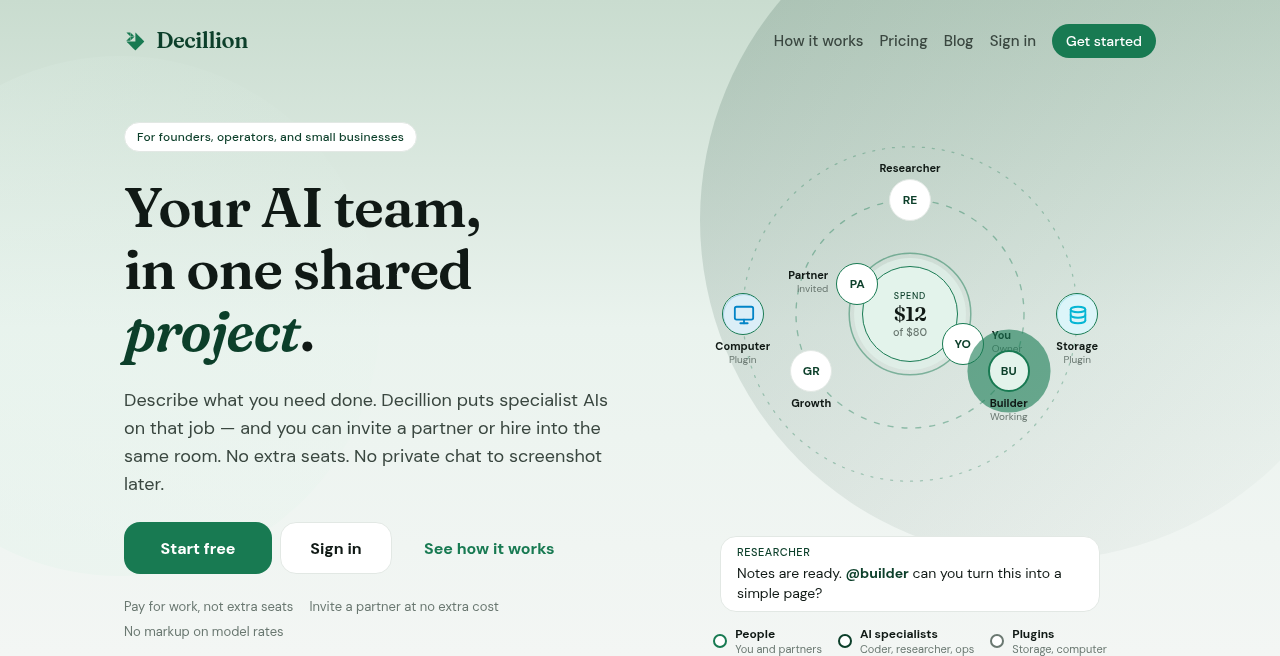
Decillion AI is a web-based multi-agent workspace that lets small teams combine specialist AI agents and human collaborators inside a single shared project. Users describe a goal, the platform assigns relevant agents, and all participants work in one persistent room where context accumulates over time.
The platform runs on a credit-pack billing model with no per-seat charges for additional human invitees. Model token costs mirror provider list prices without markup, and computer time on the built-in Linux sandbox is metered at a flat per-minute rate. Decillion targets founders, small product teams, and early-stage operators who want AI agents and human teammates working from the same context without managing multiple subscriptions.
How we scored Decillion AI
Capability lands at 14 because the agent marketplace and sandbox are real differentiators, but the actual depth of the catalog and agent quality cannot be verified from any independent source, and the platform lacks the workflow breadth of Y Build or the governance layer of TRam Studio. Ease of use scores 16: the credit-pack model and slash-command controls suggest a thoughtfully designed interface, but there are no docs, tutorials, or onboarding materials findable publicly to confirm low friction for new users. Value earns 18, the strongest sub-score, because the no-markup token pricing and no-seat-fee model are concrete and verifiable commitments that most competitors do not make; the $20 minimum entry and transparent per-minute compute billing are genuinely fair for the target user. Delivery drops to 10 because zero independent reviews, case studies, or user sentiment exist in public sources, making it impossible to confirm the platform delivers on its claims; combined with the submitted pricing model being listed as FREEMIUM when the live page shows no free tier, there is a meaningful gap between what is claimed and what can be verified.
Pros and cons
What we liked
- No markup on model provider token rates: the per-million prices shown in the agent catalog match the underlying provider's public API pricing exactly, which is a concrete and verifiable commitment most agent platforms do not make.
- No seat fee for human collaborators: inviting a co-founder or contractor into a project costs nothing beyond the credits the agents actually consume, which keeps small-team costs predictable.
- Unified Linux sandbox and GUI desktop on one VM: computer use and sandbox tasks share a single machine billed at 12 credits per minute, avoiding double-billing for what is functionally the same compute resource.
Where it falls short
- No free tier and no trial credits confirmed on the pricing page: the minimum entry point is a $20 credit pack, which means there is no zero-cost way to evaluate whether the agent catalog meets your specific needs before spending money.
- The platform is early-stage with thin independent coverage: no third-party reviews, benchmarks, or case studies were findable, making it impossible to verify how well the agents actually perform on real workloads compared to Y Build or Orkas.
- App Store purchases carry a price premium: the same $20 credit pack costs approximately $22.99 through the App Store because Apple's cut is passed to the buyer, creating a meaningful price difference depending on how you top up.
Key features
Decillion AI pricing
Credit-pack model: $20 for 2,000 credits, $50 for 5,000 credits, $100 for 10,000 credits. No monthly seat fee. Model tokens billed at provider list rates with no markup. Computer and sandbox time billed at 12 credits per minute. No free tier confirmed on the pricing page.
| Plan | Price | Who it is for |
|---|---|---|
| Credit Pack - Small | $20 | 2,000 credits. App Store price is approximately $22.99. Credits are used for model tokens and computer time. No monthly fee, no seat charges. |
| Credit Pack - Medium | $50 | 5,000 credits. App Store price is approximately $57.99. Same usage rates apply: tokens at provider list prices, computer time at 12 credits per minute. |
| Credit Pack - Large | $100 | 10,000 credits. App Store price is approximately $114.99. No additional perks or tier benefits beyond the larger credit balance. |
Pricing reflects what we saw at time of review (2026-09). Always confirm current pricing on the tool's own site.
Who should use Decillion AI?
Decillion fits a co-founder pair or a small startup team that wants AI agents handling research, drafting, or code tasks inside the same room where the humans are making decisions. The usage-based model works well when workloads are uneven: a week of heavy agent activity followed by a quiet week costs only what was actually consumed, not a flat monthly fee regardless of use.
Anyone running a regulated workflow, needing a full audit trail, or managing a larger team with role-based permissions should look elsewhere. TRam Studio is the better fit there: it is built explicitly for enterprise governance and auditability on Azure, and it has a pilot program that Decillion does not appear to offer. Similarly, teams that want a local-first, open-source setup with a visible agent coordination layer should consider Orkas instead.
Skip it if: Enterprise teams needing governance, auditability, or deep integration libraries
Decillion AI alternatives
Frequently asked questions
Is there a free plan or trial?+
The pricing page does not list a free tier or trial credits. The minimum entry point is a $20 credit pack for 2,000 credits.
How much does it cost to run an AI agent for an hour?+
Computer and sandbox time costs 12 credits per minute, so one hour of continuous VM use costs 720 credits, which is $7.20 at the $20-per-2,000-credits rate. Token costs for the model running on that machine are additional and vary by the agent's listed provider rate.
Do I pay more if I invite a teammate?+
No. Adding a human collaborator to a project carries no seat fee. You only pay for the credits agents consume while working.
Are model token prices marked up?+
No. The pricing page states explicitly that token rates match the underlying provider's public per-million prices with no added percentage. Default fallback rates are 300 credits per 1M input tokens and 1,500 credits per 1M output tokens, but listed agents use their own stated rates.
Can I withdraw unused credits?+
Prepaid credits cannot be withdrawn. Only settled creator earnings held in USD can be withdrawn from the wallet.
Does buying through the App Store cost more?+
Yes. The $20 web pack costs approximately $22.99 on the App Store, the $50 pack approximately $57.99, and the $100 pack approximately $114.99, because Apple's cut is passed to the buyer.
More AI Agents & Automation tools
See all categoriesGet your tool listed on 300+ directories.
One listing here is a strong start. But the founders who get discovered everywhere are listed everywhere. Our sister site, Free AI Directories, submits your tool to 300+ AI directories for you, every single one by hand, by a real person.
It is a one-time payment of $49, no subscription, and you can follow along as the submissions land. Prefer the slow route? The same site keeps a free list of 450+ directories you can work through yourself.
Get my tool listed on 300+ directoriesOne-time payment, no subscription · 100% human submissions · Free list of 450+ directories included.