
superagnt_
A single MCP endpoint that gives any AI agent live social data, lead enrichment, web scraping, a real Postgres database, memory, queues,
Are you the maker? Claim this listing to keep info, pricing and screenshots current. Verified via your tool's domain email.
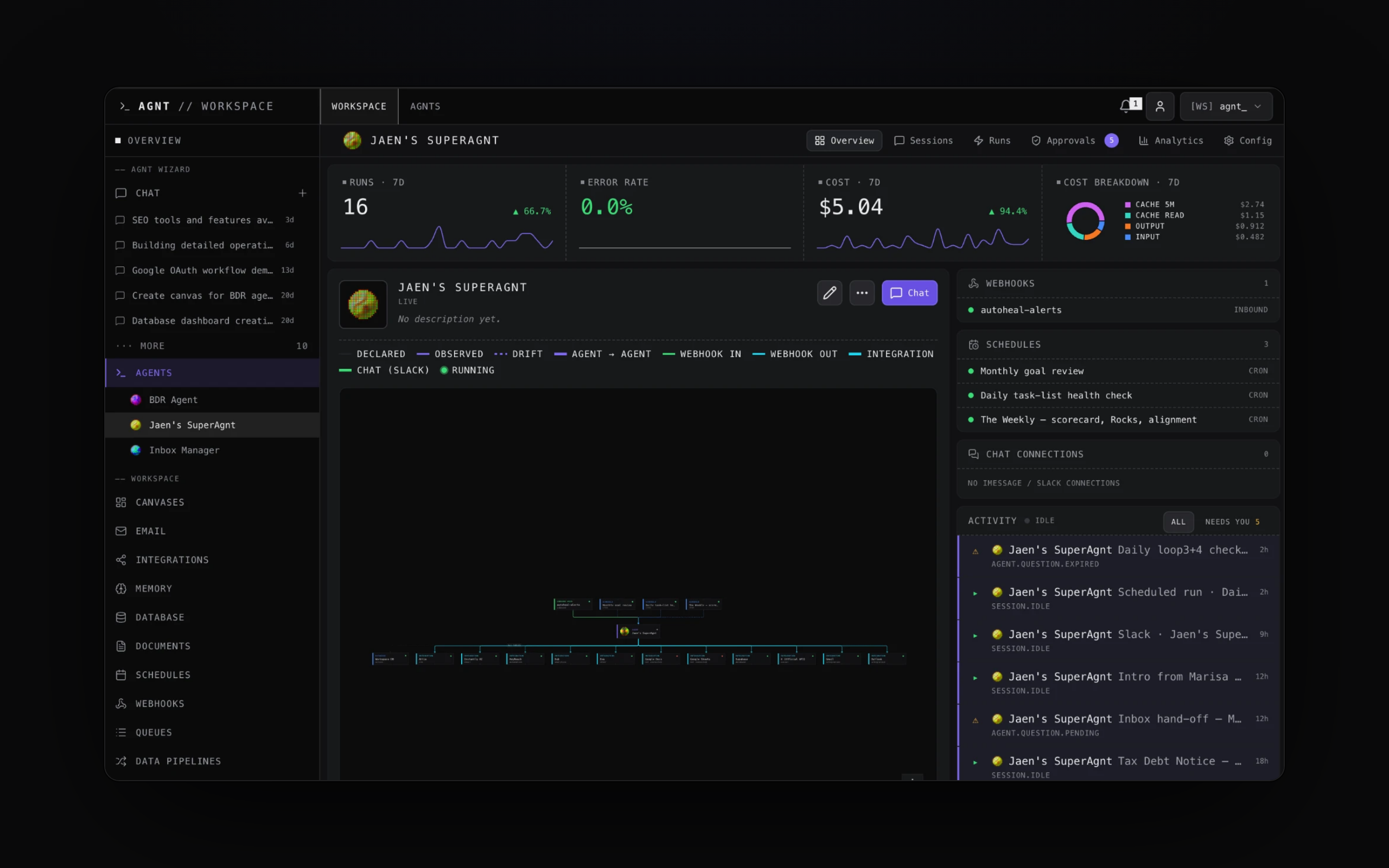
Developers running autonomous agents in Claude, Cursor, or Codex get a genuinely useful shortcut here: one API key replaces a scraping stack, a database, and several enrichment subscriptions. The credit-on-success billing model is fair, but the product is early and the pricing page does not publish per-credit costs or tier limits in enough detail for a buyer to forecast spend. Teams that need enterprise governance or audit trails should look at TRam Studio instead.
What is superagnt_?
superagnt_ is a hosted MCP server and REST API that gives AI agents a unified set of external tools through one endpoint and one API key. Its capabilities include live social media data from platforms such as Instagram, TikTok, YouTube, LinkedIn, X, and Reddit; lead enrichment and email finding; web scraping and crawling; a dedicated 10 GB Postgres database per workspace; shared memory; task queues; schedules; and an inbox. A canvas feature lets agents publish live SQL-backed dashboards shareable by link.
The service works with any MCP-compatible agent runtime, including Claude Desktop, Claude Code, Codex, Cursor, VS Code, Gemini CLI, Windsurf, and others. Credits are charged only on successful responses. A key can be self-minted without signup or a credit card, and paid plans start at $19 per month. The primary audience is developers building autonomous agents who need data access and persistent storage without assembling a multi-vendor API stack.
How we scored superagnt_
Capability lands at 19 because the tool surface is genuinely broad: seven social platforms, a real 10 GB Postgres database per workspace, lead enrichment, web scraping, schedules, queues, and a canvas layer, all behind one key. That breadth is real and would cost significantly more to assemble from separate vendors. Ease of use scores 18 because the self-mint key flow and the public setup prompt URL lower onboarding friction meaningfully, and the dual MCP/REST surface covers nearly every major agent runtime. Value drops to 16 because the pricing page does not publish per-credit rates or credit volumes, making it impossible for a buyer to forecast spend at the $19/month entry point; opacity in pricing is a real cost to the buyer even if the underlying model is fair. Delivery scores 11 because the product has no confirmed social presence, no published user counts, no third-party reviews, and no track record evidence available at review time, which makes it genuinely hard to assess whether the tool delivers on its claims in production at any meaningful scale.
Pros and cons
What we liked
- One API key replaces a scraping stack, a Postgres database, and multiple enrichment subscriptions, covering Instagram, TikTok, YouTube, LinkedIn, X, Reddit, Facebook, web crawling, and lead enrichment in a single surface.
- The 10 GB isolated Postgres database per workspace is a real relational database the agent controls with SQL, not a key-value store or a markdown folder, which meaningfully raises the ceiling on what an agent can build and retain.
- Credits are charged only on successful responses, and a key can be self-minted in one API call with no signup and no credit card, making the entry cost genuinely zero for initial testing.
Where it falls short
- The pricing page does not publish per-credit rates or credit volumes per tier, so a developer cannot forecast monthly spend before committing to a paid plan. This is a specific gap relative to competitors like Cronloop, which publishes its limits clearly.
- The canvas and dashboard feature, while visually compelling in the demo, has no documented sharing permissions or access controls, meaning any link recipient can view the data an agent pins there.
- The product is early-stage with a small public footprint: no confirmed social media presence was found, no published user counts, and no third-party reviews, making it hard to assess reliability or support responsiveness before depending on it in production.
Key features
superagnt_ pricing
Free entry with no signup required (self-mint a key in one call, no card). Paid plans start at $19/month. Pay-as-you-go credits are charged only on successful responses. Exact per-credit rates and credit volumes per tier were not published on the pricing page at review time.
| Plan | Price | Who it is for |
|---|---|---|
| Free | Free | Self-mint an API key in one call, no signup, no credit card. Access to the full tool surface; credits charged only on successful responses. Exact free credit allowance not published on the pricing page. |
| Pay-as-you-go / Starter | $19/mo | Paid entry tier starting at $19/month. Per-credit rates and included credit volumes were not published on the pricing page at review time; a [PRICING] flag has been raised for the human editor to verify. |
Pricing reflects what we saw at time of review (2026-09). Always confirm current pricing on the tool's own site.
Who should use superagnt_?
A solo developer running a Claude Code or Cursor agent for sales prospecting, content monitoring, or competitive research will get the most from superagnt_. The database layer alone saves significant setup time: the agent can create tables, insert scraped records, and query them with SQL without the developer provisioning any external database. The credit-on-success model also suits low-volume experimentation where paying for failed calls would sting.
Founders building lightweight autonomous pipelines, such as a weekly Instagram analytics tracker that writes to a database and surfaces results on a shared dashboard, are a natural fit. Who should look elsewhere: teams that need role-based access controls, audit logs, or compliance documentation should consider TRam Studio, which is built around enterprise governance from the ground up. Developers whose agents primarily need scheduled unattended runs rather than live data access may find Cronloop a simpler and cheaper fit for that specific job.
Skip it if: Enterprise teams needing governance, audit logs, or predictable per-seat pricing
superagnt_ alternatives
Tags
Frequently asked questions
Do I need to sign up or give a credit card to try superagnt_?+
No. A key can be self-minted in a single API call with no account creation and no card required. Credits are only charged on successful responses, so failed calls do not cost anything.
What database does superagnt_ give my agent?+
Each workspace gets an isolated 10 GB Postgres instance. The agent can create tables, run SQL, run migrations, and load CSVs via tool calls. It is a full relational database, not a key-value store.
Which agent runtimes does superagnt_ support?+
The product page lists Claude Desktop, Claude Code, Codex, Grok, ChatGPT, Cursor, VS Code, Gemini CLI, Windsurf, Zed, Cline, and a generic HTTP option, covering most major agent environments.
What does the paid plan cost and what does it include?+
Paid plans start at $19/month. The pricing page at review time did not publish per-credit rates or credit volumes per tier, so exact spend forecasting requires contacting the team or testing on the free tier first.
Which social platforms can my agent pull data from?+
Instagram, TikTok, YouTube, Reddit, Facebook, X (Twitter), and LinkedIn are all covered. No separate API keys or scraping infrastructure are required from the developer.
Can superagnt_ replace a dedicated enrichment tool like Apollo or Hunter?+
For agents that already use superagnt_ for data and database work, the built-in email finder and people enrichment tools reduce the need for a separate enrichment subscription. Whether it matches the depth of a dedicated enrichment platform is not verifiable from published documentation alone.
More AI Agents & Automation tools
See all categoriesGet your tool listed on 300+ directories.
One listing here is a strong start. But the founders who get discovered everywhere are listed everywhere. Our sister site, Free AI Directories, submits your tool to 300+ AI directories for you, every single one by hand, by a real person.
It is a one-time payment of $49, no subscription, and you can follow along as the submissions land. Prefer the slow route? The same site keeps a free list of 450+ directories you can work through yourself.
Get my tool listed on 300+ directoriesOne-time payment, no subscription · 100% human submissions · Free list of 450+ directories included.