How to Read Your AI Visibility Checker Results
Learn what an AI visibility checker measures, how to run a repeatable test, and how to read mentions and citations before you decide what to fix.
If a company ranks well in search, does that mean an AI assistant will recommend it or cite its website? Not necessarily. A ranking report shows a page's position. An AI visibility checker examines what a generated answer says and which sources it uses.
The useful result isn't a single score. It's a pattern across prompts, engines, markets, and repeated runs. Reading that pattern correctly helps a marketing team choose between fixing an inaccessible page, correcting an outside source, or publishing content that answers a buyer's question.
Table of Contents
- Visibility Metrics and What Each One Tells You
- Why Results Change From Run to Run
- How to Run a Repeatable Visibility Test
- Reading Mentions and Citations Together
- Tracing the Sources Behind an AI Answer
- Set a Baseline and Decide What to Fix First
Visibility Metrics and What Each One Tells You
A search ranking and an AI answer measure different outcomes. A page can occupy a strong position in a results list without becoming the source an answer engine cites. A brand can also appear in an answer without its website receiving a link.
A Performance.io and Semrush study reported by the Rutland Herald examined 689,100 U.S. desktop keyword snapshots across five pharmaceutical topics and found that, when a Google AI Overview appeared, the number-one organic domain was cited in 68.8% of snapshots. That's evidence of a relationship, not a guarantee that a leading organic result becomes an AI citation.
Core Visibility Metrics and What They Answer
| Metric | What It Counts | Question It Answers |
|---|---|---|
| Mention rate | Share of tested answers that name the brand | Does the AI bring the brand up at all? |
| Citation rate | Share of answers that link to pages on the brand's domain, including subdomains | Does the AI direct readers to owned content? |
| Third-party citation rate | Share of answers citing review sites, directories, forums, or competitors | Which outside sources shape the answer? |
| Citation share by source type | Breakdown of citations by category, such as owned site, review platform, or forum | Which source types carry the most weight? |
| Cross-engine agreement | Share of tested engines that name the brand for the same prompt | Is visibility shared across platforms or limited to one? |
| Repeatability | Share of repeated runs that produce the same mention or citation | Is the result consistent or just a snapshot? |
The denominator matters. A citation rate calculated across all tested answers isn't interchangeable with a citation rate calculated only among answers that mention the brand. Reports should label that distinction before anyone compares campaigns or competitors.
Teams moving from conventional reporting can use this SEO visibility checker guide to keep search-result exposure separate from generated-answer exposure. They should retain both measures rather than replace the ranking dashboard with an unexplained AI score.
Tool discovery is a separate task from measurement. For a startup building a shortlist, NZ Apps offers a resource to find AI software for startups. Each candidate still needs evaluation against the reporting fields above.
A mention without a citation suggests a different issue from a citation without a mention. Combining them into one score hides the distinction that determines the next fix.
Why Results Change From Run to Run
A single checker run can produce a valid observation without producing a reliable conclusion. It records what happened under particular conditions. It doesn't establish how consistently a brand appears.
A multi-engine visibility analysis discussed by Minuttia found that 54% of recommended brands appeared in only one engine's answers, while 8% were named by all five engines tested. Those findings make cross-platform coverage a measurement question, not something a team should assume.
Treat Visibility as a Distribution
Prompt wording changes the task. A request for affordable project management software invites different recommendations from a request for project management software with advanced permissions. Combining those results without labels can disguise a change in buyer intent as a change in brand performance.
Location also changes the relevant providers, evidence, and availability. Personalization, model updates, and temporary retrieval differences can affect an answer. A lone result can't identify which factor caused an omission.
Interpretation rule: A brand that appears consistently in one engine but disappears elsewhere has narrow visibility, not proven strength across AI search.
Repeated observations should therefore remain grouped by engine, market, language, and prompt intent. An overall average can summarize the report, but it shouldn't replace those breakdowns.
Separate Movement From Measurement Noise
Report the observed mention share alongside its spread across runs. Keep the underlying answers available so reviewers can distinguish a genuine recommendation from a passing reference or a negative comparison.
A confidence interval can help describe sampling uncertainty, but only when its assumptions are defensible. Repeated answers from closely related prompts aren't automatically independent observations. Adding more near-duplicate questions doesn't necessarily produce broader evidence.
A website visibility checker guide can help teams distinguish site-level diagnostics from answer-level monitoring. A page inspection answers an accessibility question; repeated answer sampling addresses consistency.
Action doesn't require agreement everywhere. A local provider may care most about a particular market and engine. The important point is to define that scope before interpreting a favorable result as general visibility.
How to Run a Repeatable Visibility Test
A useful test starts with buyer questions, not a dashboard score. The procedure needs a stable prompt set and a record that another reviewer can inspect.
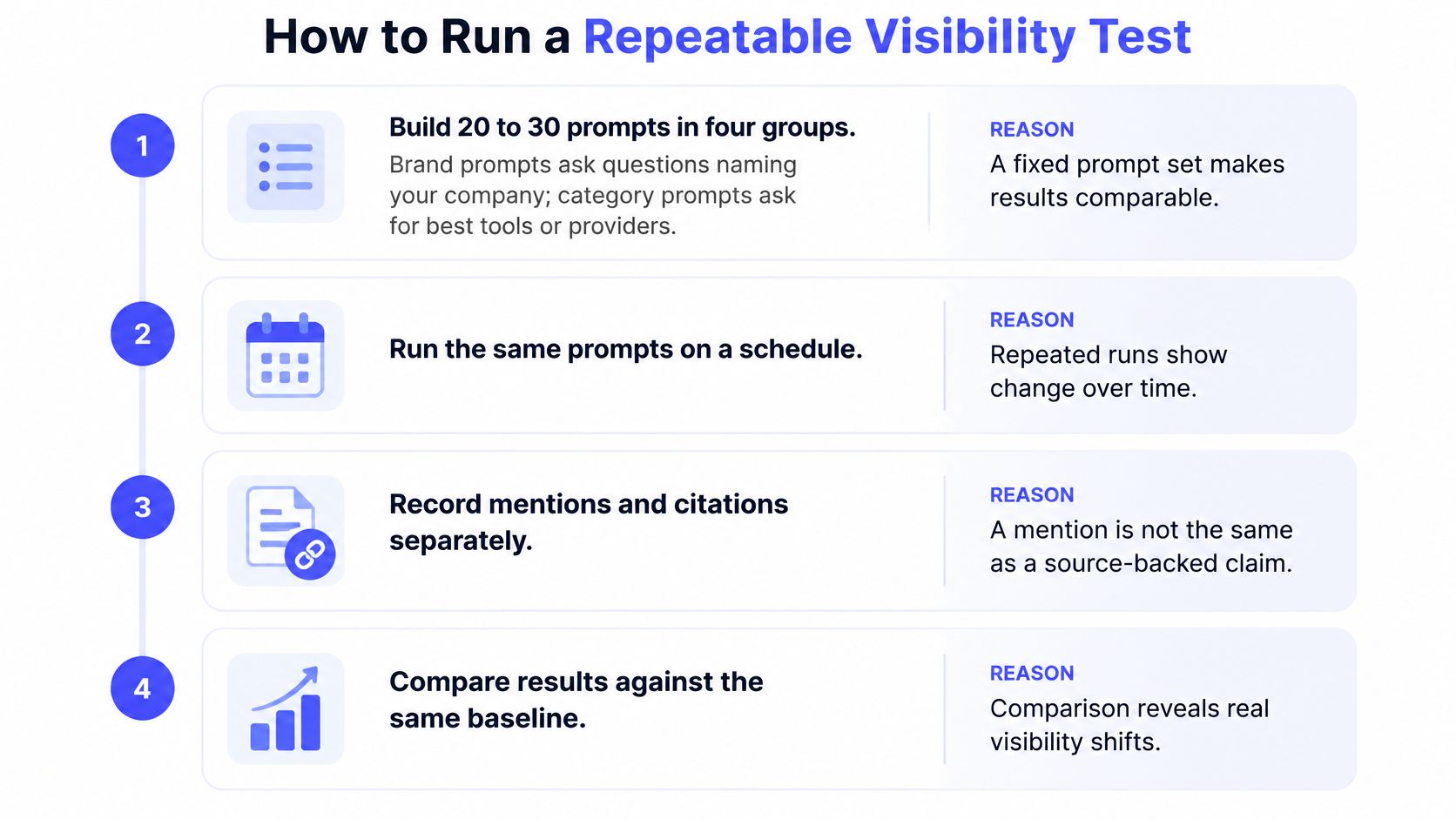
The workflow below keeps prompt selection, repeated collection, tagging, and comparison connected.
Build the Test and Preserve the Evidence
Create a balanced prompt set. As a practical starting exercise, build 20 to 30 prompts across four groups: brand questions naming the company, category questions without its name, comparisons with named competitors, and problem questions buyers ask before knowing any provider. Testing only branded questions makes recognition look like discovery.
List the company name, product names, domain variants, and subdomains before collection begins. Include genuine aliases, but review ambiguous names manually so ordinary words don't become false mentions.
Choose the relevant engines, country, and language. Use the markets and platforms that matter to the intended buyers, and record the available model or interface details. The common mistake is combining different configurations under the same label.
Run each unchanged prompt several times across several days on a documented schedule. Keep deliberate wording experiments in a separate test group, since editing prompts makes later comparisons hard to interpret.
Save the query, model, date, country, and full response for every run. Preserve visible citation destinations as well as answer text, because screenshots or summaries alone may omit the evidence needed for diagnosis. Logging an answer without its collection context creates an observation that can't be compared confidently.
Tag brand mentions, owned-domain citations, and external citation domains separately. Check whether a link supports the nearby claim, rather than treating every linked page as evidence for the whole answer.
Preserve the first collection as the baseline. Compare later collections against that fixed reference and retain the intervening history. Overwriting the original results makes gradual changes difficult to separate from recent fluctuations.
Keep the Workload Useful
The prompt count is a starting recommendation, not a statistical threshold. A specialist service with a narrow offering may need deeper coverage of closely related buyer problems. A broad software platform may need separate prompt sets for distinct products and audiences.
A fixed prompt set improves comparability. A representative prompt set improves relevance. A useful test needs both.
Before expanding collection, inspect the tagging rules. Decide how the report handles subsidiaries, product-only mentions, redirected links, and answers that refuse to recommend anything. Document exclusions rather than removing unfavorable results.
The output should be an auditable worksheet or export, not just a chart. Each result needs enough context for a content specialist to identify the exact page, claim, or missing answer that deserves attention.
Reading Mentions and Citations Together
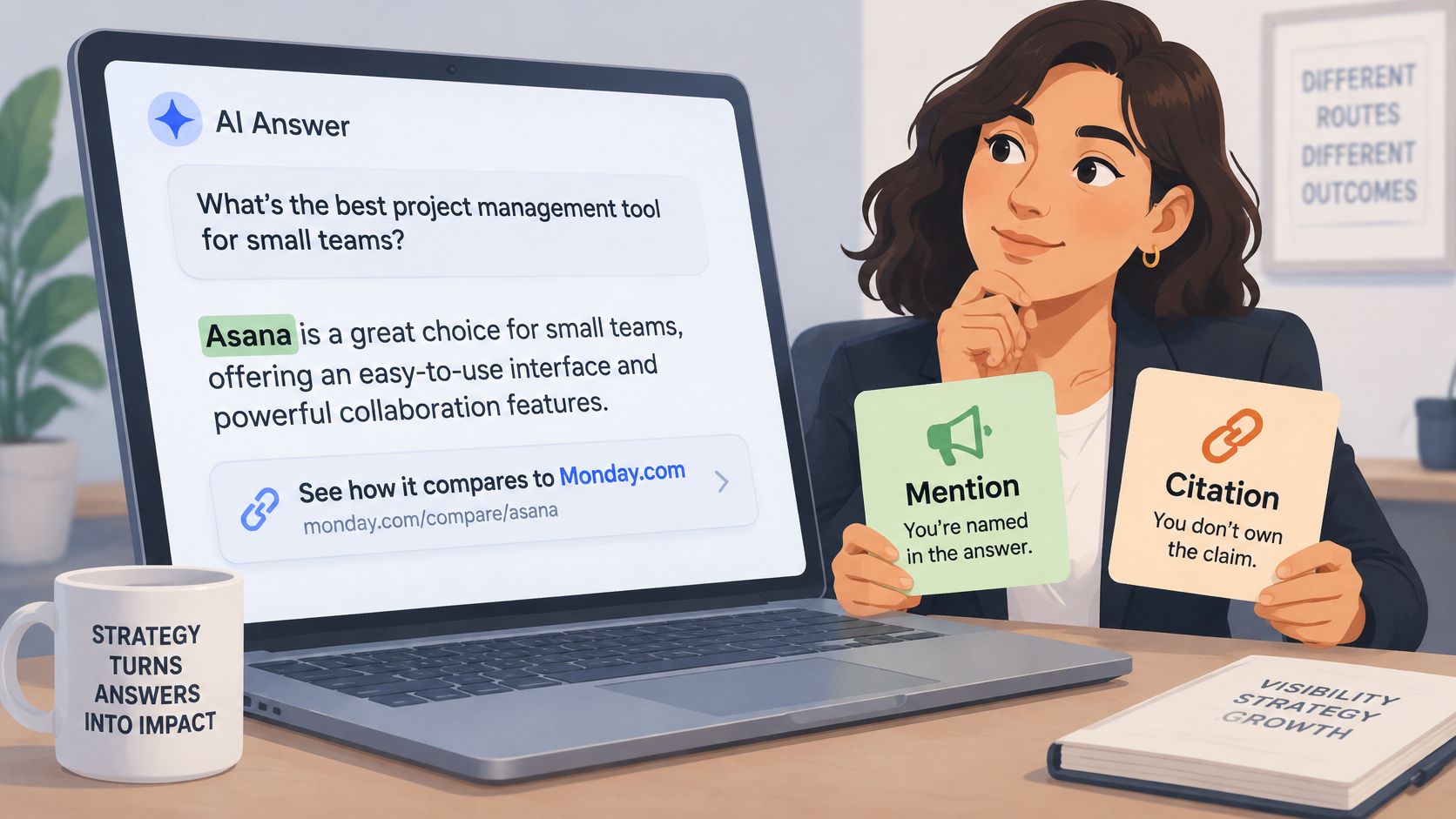
Say an answer names a scheduling platform but cites a competitor's comparison page. The platform received a mention, yet the competitor supplied the supporting description. Publishing another general company introduction wouldn't necessarily address the source of that description.
The distinction is explicit on Rank.ai's AI visibility checker page: a mention records whether the answer brings up the business, while a citation records links to pages on its domain, including subdomains. Rank.ai describes checking answer text for the business name and domain and counting links to the site.
The visual distinction is straightforward, but the operational consequences differ.
Mention and Citation Patterns, Causes and Next Moves
Treat the causes below as working hypotheses, not diagnoses proven by the score.
| Pattern | Likely Cause | Next Move |
|---|---|---|
| Mentioned but rarely cited | Brand known from third-party lists, but no owned page answers the prompt | Update or publish a page that answers the exact prompt |
| Cited but not mentioned | The page is retrieved, but the answer does not name the brand | Make the brand name and product description clear on the cited page |
| Named with a competitor or review page cited | Outside sources carry the claim for the category | Trace the cited source and check whether its claims are accurate |
| Absent from every engine | Neither owned content nor leading sources adequately answer the prompt | Test brand and category prompts separately, then fill the content gap |
| Present in one engine only | Visibility is narrow or engine specific | Repeat runs before acting on a single-engine result |
For a rarely cited brand, inspect the relevant owned page before creating a new one. The answer may already exist but be buried beneath navigation, promotional language, or an unclear heading. A focused update avoids unnecessary duplication.
For a cited but unnamed brand, clarify ownership and product identity where the useful explanation appears. Repeating the company name throughout the page isn't the objective. Readers and retrieval systems need an unambiguous connection between the information and its publisher.
External citations require claim checking, not an automatic campaign to replace them. An accurate independent review can be useful evidence. An outdated comparison that misstates a capability deserves a correction request.
Complete absence also warrants a technical check before a content expansion. The fix should follow the observed pattern, not the total score.
Tracing the Sources Behind an AI Answer
Which source is doing the work in the answer? That question matters more than whether a report displays a favorable badge.
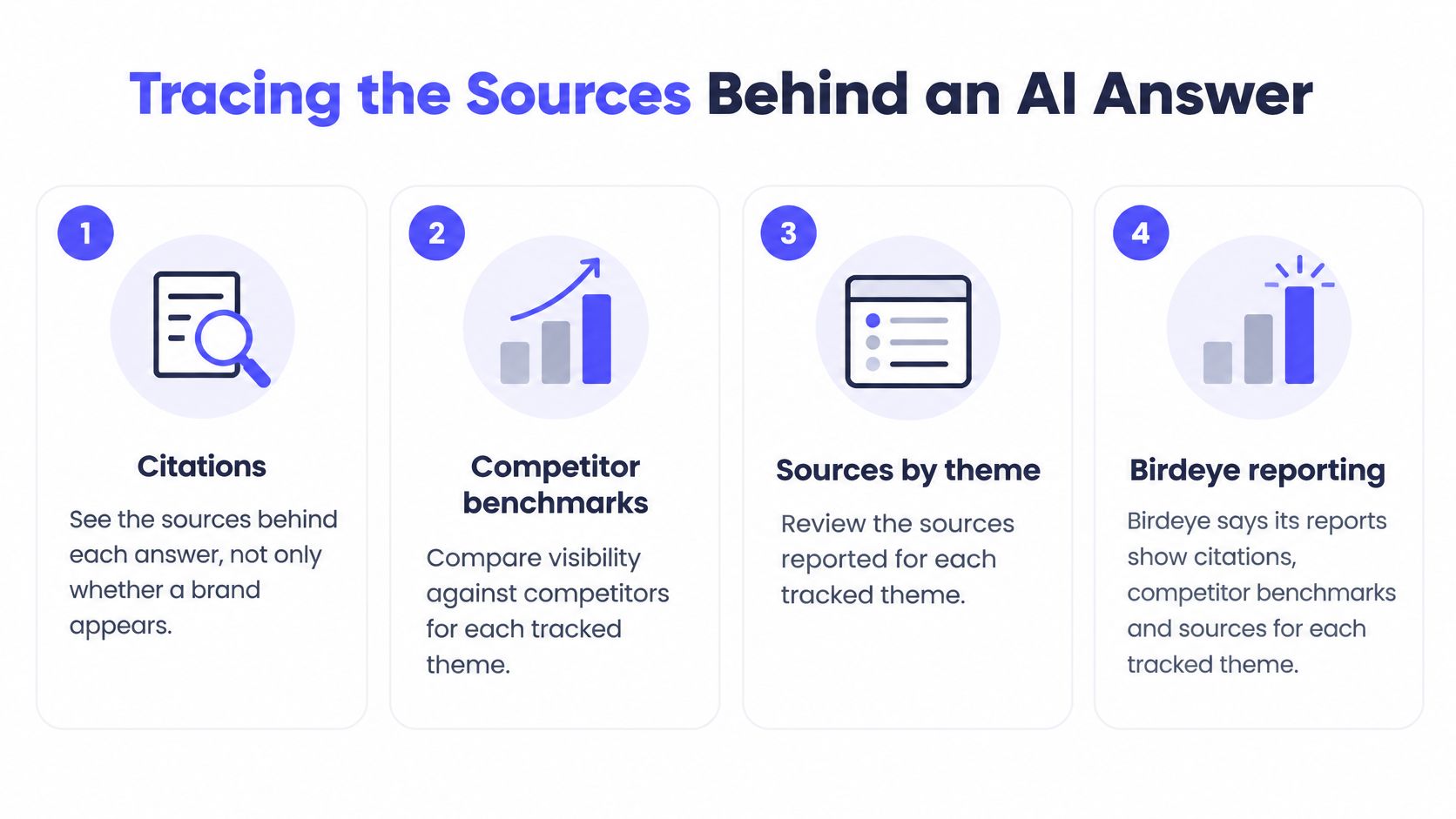
According to Birdeye's AI visibility checker page, its reports show citations, competitor benchmarks, and sources for each tracked theme. Those sources can include review platforms, business listings, directories, the company website, and third-party mentions.
Source tracing turns those report fields into a review queue.
Audit the Claim Before Changing Content
For every influential cited page, record answers to these questions:
- Accuracy: Does the page support the statement in the generated answer?
- Currency: Does it describe the current product rather than a discontinued version?
- Pricing and capabilities: Do its claims match the official offer, restrictions, and supported functions?
- Influence: Can the company edit the page, request a correction, or only monitor it?
Ahrefs belongs in this source-analysis category when assessing cited domains and individual pages. Rank.ai addresses the mention-versus-owned-citation distinction. Neither task should be confused with inspecting what content a crawler can access.
Check the Machine-Readable Page
Adobe's AI Content Visibility Checker first attempts to fetch a page as ChatGPT's web crawler would. If that fails, it uses the initial HTML before JavaScript runs as a proxy, then compares that view with the fully rendered human version.
Its citation readability score measures the portion of content visible to AI. A higher score indicates stronger machine readability, not a guaranteed citation or proof that every engine sees the same page.
If the comparison reveals missing product descriptions or pricing details, a developer can investigate server-side rendering or prerendering for that content. Improving machine access won't resolve an inaccurate outside review, just as correcting a directory listing won't fix hidden page content.
These tools cover different jobs, so selection should follow the evidence needed. Where available, consult the tool's AI Tool Seekers review and alternatives or comparison pages, then verify current pricing and trial terms on the vendor's site. A trial isn't a free plan, and neither establishes that the reporting method fits the task.
Set a Baseline and Decide What to Fix First
The first decision is which prompt group deserves attention. A broad category query may look attractive, but an inaccurate answer about a product's core capability can create a more immediate problem for buyers.
Create a baseline worksheet with mention rate, citation rate, and third-party citation rate for each prompt group. Flag mismatches between mentions and citations, then attach the underlying answers and cited pages. Keep collection settings beside the results so the baseline remains reproducible.
Prioritize Buyer Relevance and Claim Accuracy
Rank proposed fixes by how often the sales or support team encounters the question and how far the answer departs from current claims. Use actual customer questions where available rather than treating prompt popularity as something a checker automatically knows.
- Correct consequential errors first: Address misleading pricing, availability, or capability statements.
- Repair access problems next: Make business-critical explanations available in the machine-readable page.
- Fill demonstrated content gaps: Publish direct answers where relevant buyer questions remain unanswered.
For teams formalizing their comparison process, Transactional LLC's Transactional performance benchmarking guide provides a complementary resource for planning benchmarking work. Keep the AI monitoring exercise tied to a fixed reference, documented conditions, and a clear decision.
After a change, retest the same prompts with the same engines, country, and language. Compare against the original baseline, not only the preceding collection. Annotate the edit, but don't assume it caused every subsequent movement.
Choose Reporting That Supports Decisions
Select an AI visibility checker that separates mentions from citations, preserves model, date, and country details, and supports repeated collection. Review options on AI Tool Seekers before choosing, and confirm pricing and trial conditions with the vendor.
AI Tool Seekers offers four free utilities: an AI readiness checker, an AI tool finder, an AI cost calculator, and an AI visibility checker. A listing or score isn't a guarantee of a third-party tool's quality, safety, security, or business practices.
Decision standard: Monitoring should identify a defensible next action, not promise a favorable outcome.
Being listed on AI Tool Seekers doesn't guarantee traffic, rankings, AI citations, sales, or any other outcome. A checker records answer behavior; it doesn't control it.
Visit AI Tool Seekers to compare reviewed AI software and explore its free visibility and readiness tools. Start with a buyer-focused prompt set, preserve the answers, and choose the tool that makes the next content or source correction clear.