Best AI Tools for SEO: How to Choose the Right One
Compare the best AI tools for SEO, from keyword research to content optimization, and find the right fit for your site, team, and budget.
Which AI SEO tool fits your workflow? Start with the job, not the tool list. If the bottleneck is finding keywords and understanding competitors, a content editor won't help. If drafts stall before they reach an editor, a backlink database won't help either. Most AI tools for SEO do one or two jobs well and treat the rest as an afterthought.
The tools below split into four groups: keyword and competitor research, content optimization, technical audits, and AI visibility tracking. Every description comes from what each vendor's own website states about its product. No tool pays to appear here, and no placement is for sale. Pricing and limits change often, so confirm the current numbers on the vendor's site before you commit.
The list is ordered by job, so jump to the category that matches the work in front of you. For a broader view of the best AI SEO tools across categories, that comparison makes a useful starting point.
Table of Contents
- 1. Surfer SEO
- 2. Semrush
- 3. Surfer
- 4. Ahrefs
- 5. Frase
- 6. Clearscope
- 7. Writesonic
- The Best AI Tools for SEO at a Glance
- Pick by Job, Then Verify Before You Buy
1. Surfer SEO
Surfer SEO belongs to the content optimization group, and its entry in the AI Tool Seekers directory shows how to size up a tool of this kind before paying. The Surfer SEO listing on AI Tool Seekers places it among SEO software for creating and improving search-focused content. Each listing there is reviewed by a person rather than added automatically, and carries pricing, features, pros, and cons alongside an editorial score.
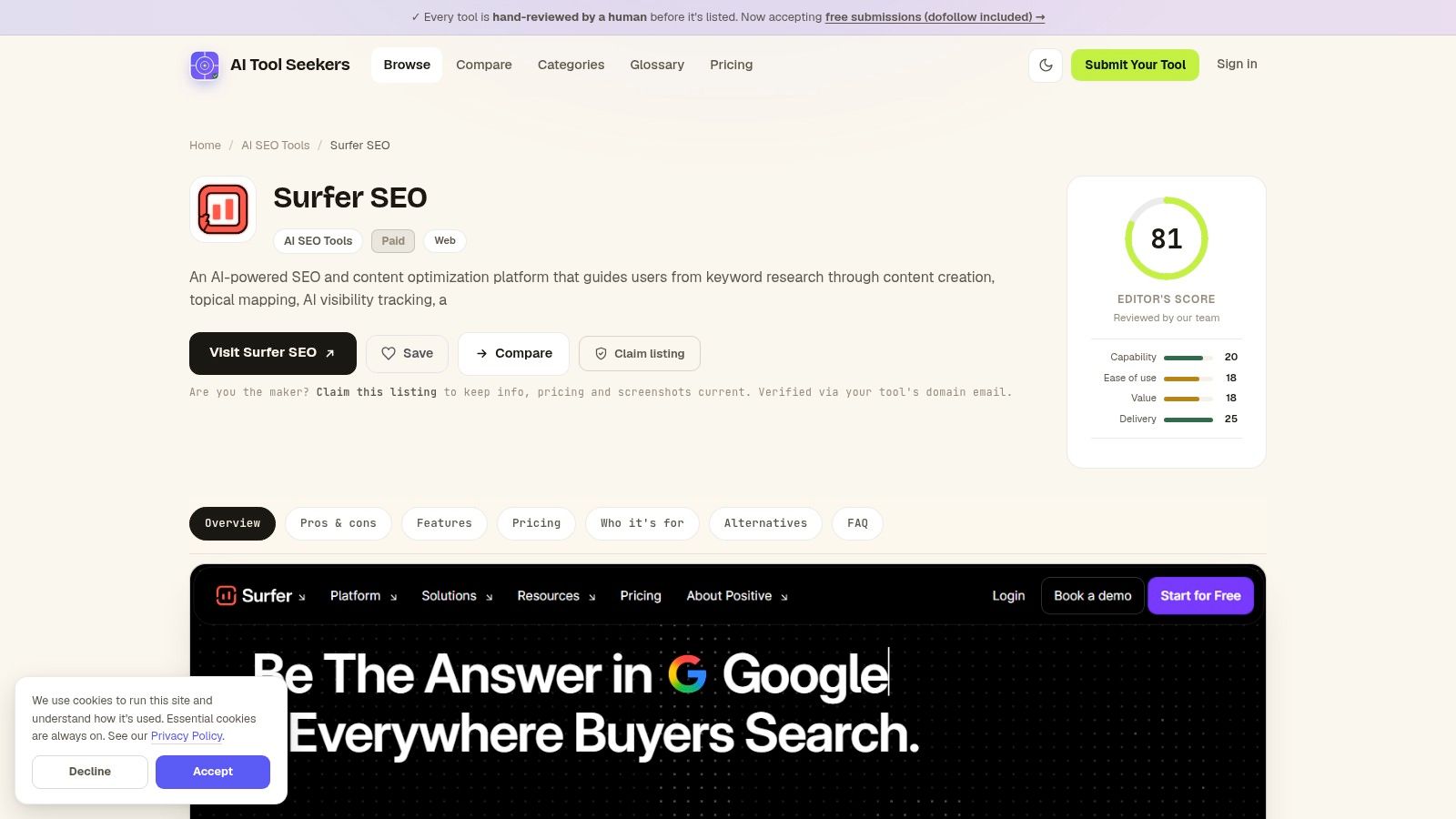
The preview doesn't carry a full breakdown of plans and capability. For what is included today, the vendor's own site stays the source of truth.
Why the check comes before the purchase
Google's position is clear. In its February 2023 guidance on AI content, automation itself is permitted, while content produced mainly to manipulate rankings breaks the rules. Google's spam policies apply the same standard to mass-produced pages regardless of whether a person or a machine wrote them. A content tool has to help you stay on the right side of that line.
Practical rule: judge a content tool by what it does before a draft exists, not by how fast it fills a page.
Google's documentation on generative AI content adds a second requirement. Fact-checking covers titles, meta descriptions, structured data, and image alt text, not just body copy. A tool that generates those elements without flagging them for review leaves cleanup work behind.
- Strengths: a human-reviewed listing you can weigh against alternatives, plus a scoring framework built on capability, ease of use, value, and delivery against claims.
- Limits: the preview confirms no pricing or feature detail, and a directory review never replaces checking the product directly.
2. Semrush
Semrush is the all-in-one suite pick: keyword research, competitor analysis, rank tracking, site audits, and AI visibility tracking inside one subscription. It earns a shortlist slot when a team wants traditional SEO and AI search workflows in the same place rather than stitching two vendors together.
The Semrush SEO and AI Search Starter plan is listed at $165.17 per month on the vendor's site. That package includes monitoring for five websites, daily tracking for 500 keywords, keyword research and optimization tools, competitor insights, daily tracking for 50 prompts, AI brand performance for one domain, 300 AI visibility reports per day, and an AI-ready Site Audit. Plans move, so confirm those numbers on Semrush's page before you budget.
Where it fits and where it doesn't
- Best for: marketing teams running a classic organic program and AI answer visibility from one dashboard, with reporting that stays consistent across both.
- Watch out for: breadth has a learning cost. A solo operator who needs one job done pays for features that go untouched, and usage limits track the plan tier rather than the size of the ambition.
The suite also covers content optimization on eligible plans, which matters if the same people write and audit. Teams that run paid and lifecycle marketing alongside organic search will get more from the wider best AI marketing tools comparison than from an SEO-only shortlist.
3. Surfer
Surfer's core product is the content editor, and that's the part teams use. It scores a draft against search-informed guidance while you write, suggests terms and structure, and connects to keyword research, topical planning, and page tracking depending on plan. Teams that publish articles on a schedule get more from it than teams whose bottleneck is technical SEO.
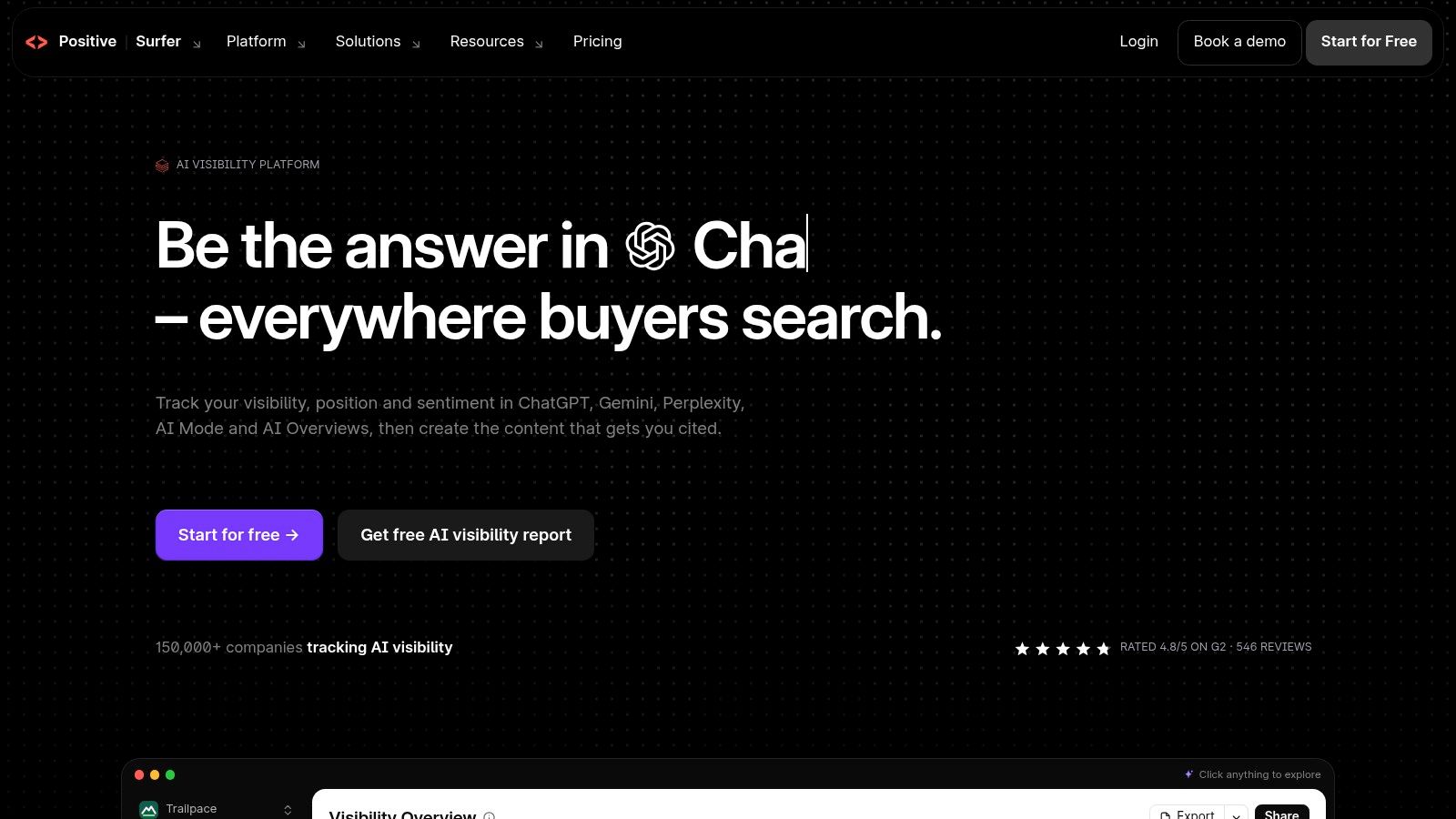
You can review the product directly at Surfer before deciding which plan fits a publishing calendar.
The human review step isn't optional
A survey of 458 SEO and content-marketing professionals found 86% of companies using generative AI, with 53% of professionals using it mainly to create a first draft and only 24% using it to generate complete content. That split matches how an editor tool works best: draft with assistance, then edit with judgment.
Content scores measure term coverage and structure. They don't measure whether a claim is true.
- Strengths: a focused workflow that improves a page before publication, useful for teams producing SEO articles regularly, plus guided resources for people new to the format.
- Limits: content scoring is guidance rather than a ranking guarantee, higher publishing volume and team seats push you to pricier plans, and it doesn't replace a full technical suite.
4. Ahrefs
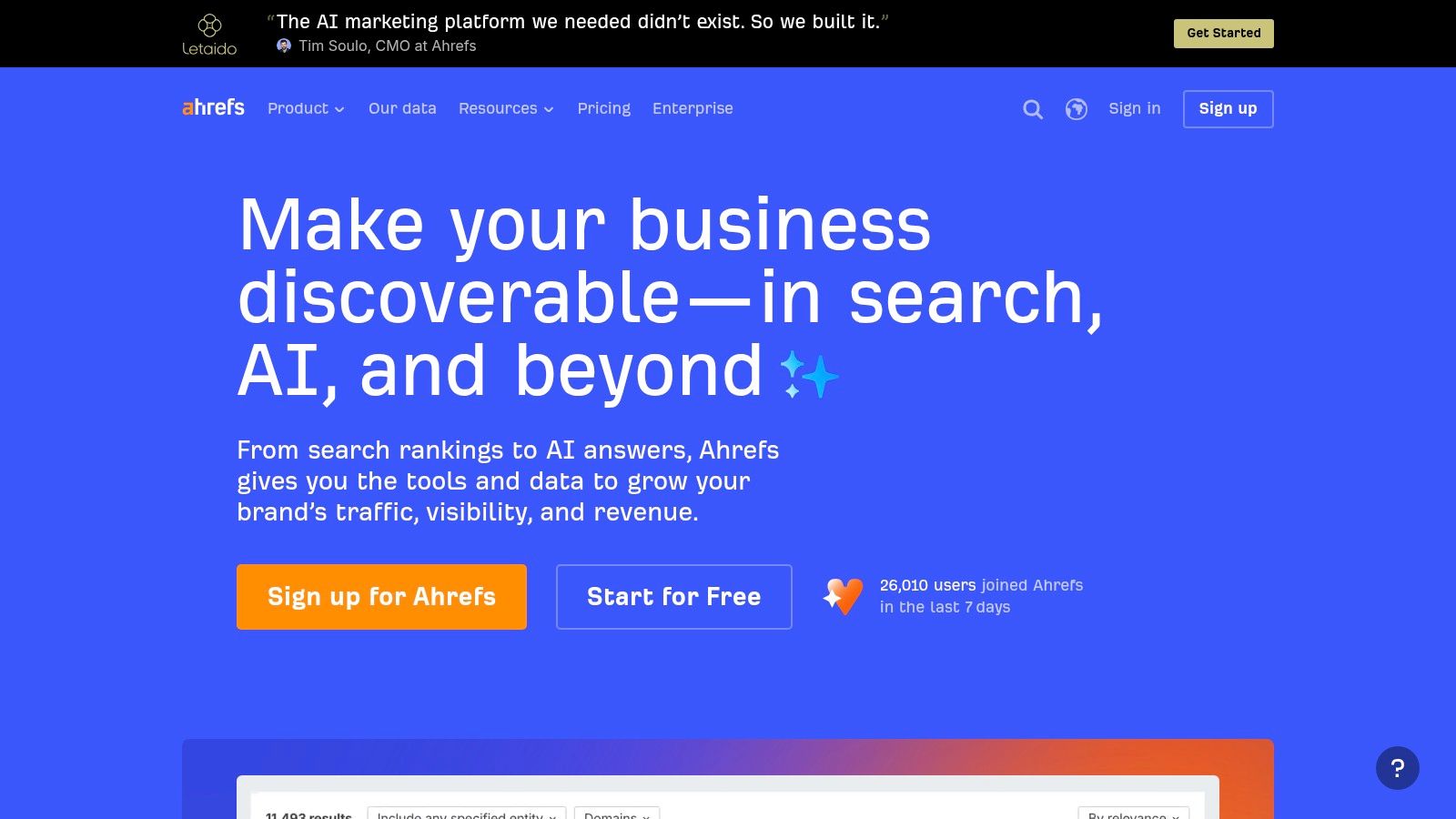
No research dataset, no strategy. Ahrefs is the pick when the job is knowing what competitors rank for, which keywords carry real demand, and what's broken on the site.
BrightEdge's channel-share research puts organic search at 53.3% of trackable web traffic, and in October 2024 the same source reported Google generating approximately 92% of organic search traffic to brands. That concentration is why research depth still decides most SEO outcomes.
What the platform covers
Site Explorer handles organic traffic and backlink research. Keywords Explorer and Rank Tracker cover demand and position. Site Audit surfaces technical problems. AI Content Helper and AI-powered search-intent features speed up briefing, and Brand Radar adds AI visibility tracking, with prompt tracking available as an option.
- Strengths: competitor, keyword, and backlink research in one place, plus free access for verified websites.
- Limits: paid subscriptions carry a real cost for individuals, some AI features and high-volume capabilities require add-ons or higher plans, and usage limits differ across subscriptions.
Pairs well with a content optimizer rather than replacing one. Browse the full AI SEO tools category to see the other options covering research and audit work.
5. Frase
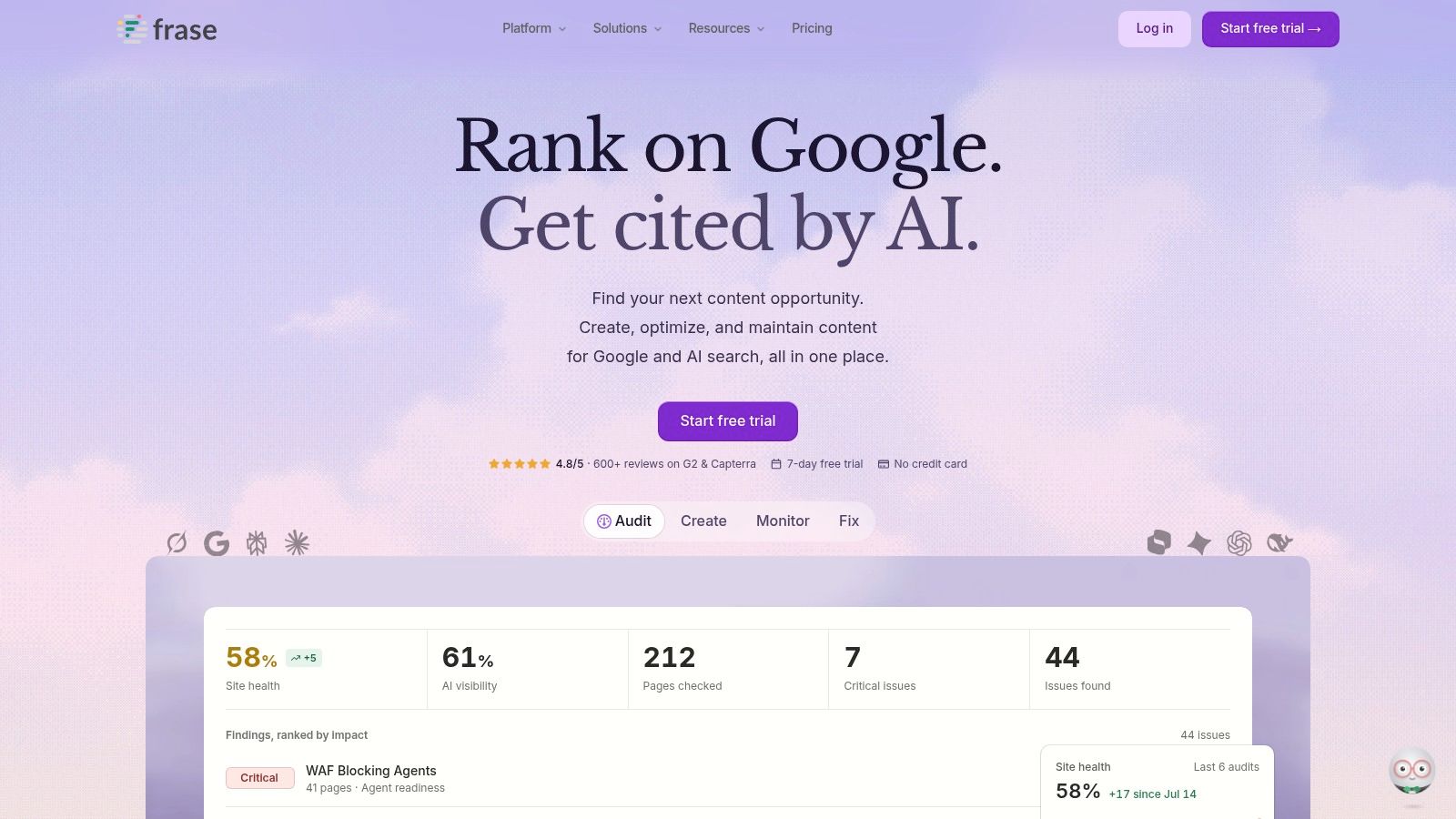
Frase covers the whole path from topic to published page: research-informed briefs, AI-assisted drafting, SEO and GEO scoring, site audits, content decay monitoring, and publishing connections to WordPress, Webflow, Sanity, and Wix. For a small content team tired of moving work between a briefing tool, a writing tool, and a CMS, it is the consolidation pick on this list.
Cheap output is not the same as useful output
AI-assisted drafting cuts production time and raises monthly output. Publishing volume on its own does not produce rankings, and a draft that ships straight to the CMS without review is a liability. What separates a page worth ranking is the evidence inside it: original data, real examples, specifics a competitor cannot copy.
Frase earns its subscription when the research side feeds that evidence into the draft. Judge the tool on whether its briefs surface topics worth publishing, then check the plan limits before committing.
- Article, audit, site, and seat allowances vary by plan, so a heavier publishing calendar pushes you into a higher tier.
- Trial terms: the vendor lists a 7-day free trial without a credit card. It is a trial, not a permanent free plan.
Fact-checking stays with a person either way.
6. Clearscope
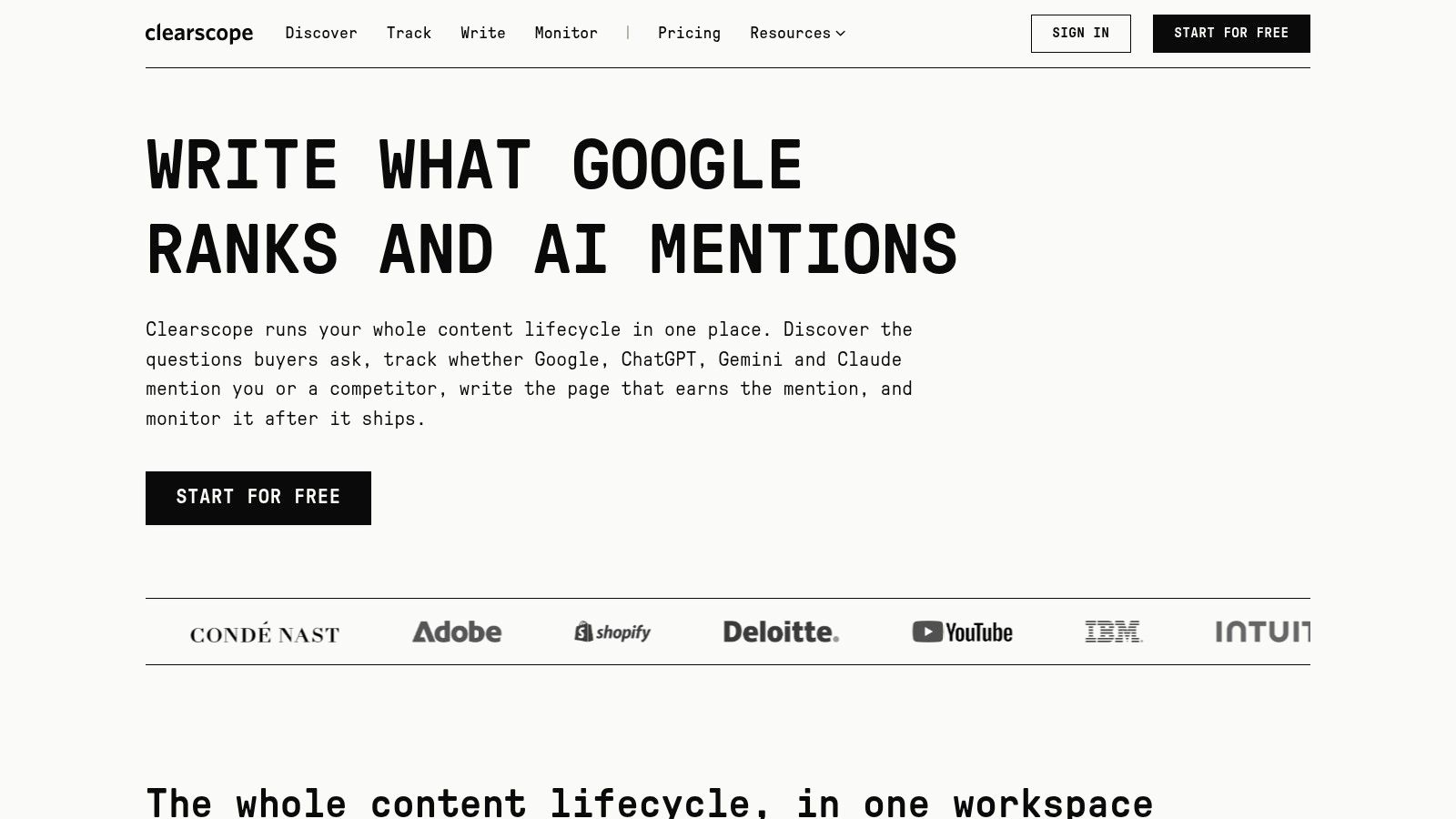
Clearscope is the editorial team's tool. Topic exploration, optimization recommendations, and visibility tracking across search results and AI answers, wrapped in a workflow built for people who publish under an editor's name rather than a content mill's.
Governance separates serious buyers from browsers
In a survey of 722 enterprise SEO professionals, 86.07% had integrated AI into their SEO strategy. The same body of reporting found 97% of companies edit and review AI-generated SEO content, while only 4% publish purely AI-generated content. That review step is where an optimization tool earns its keep or turns into extra work.
If the output needs a rewrite before it meets your standards, price the rewrite into the subscription.
- Strengths: designed around editorial workflow and content quality, onboarding and support included, and monthly plans carry no minimum contract according to Clearscope.
- Limits: entry pricing is high for individuals and infrequent publishers, draft and topic-exploration credits are capped by plan, and it's content work rather than a complete technical suite.
For a team of two or three writers, that price is real money. For a team of twelve publishing weekly, the same price buys consistency.
7. Writesonic
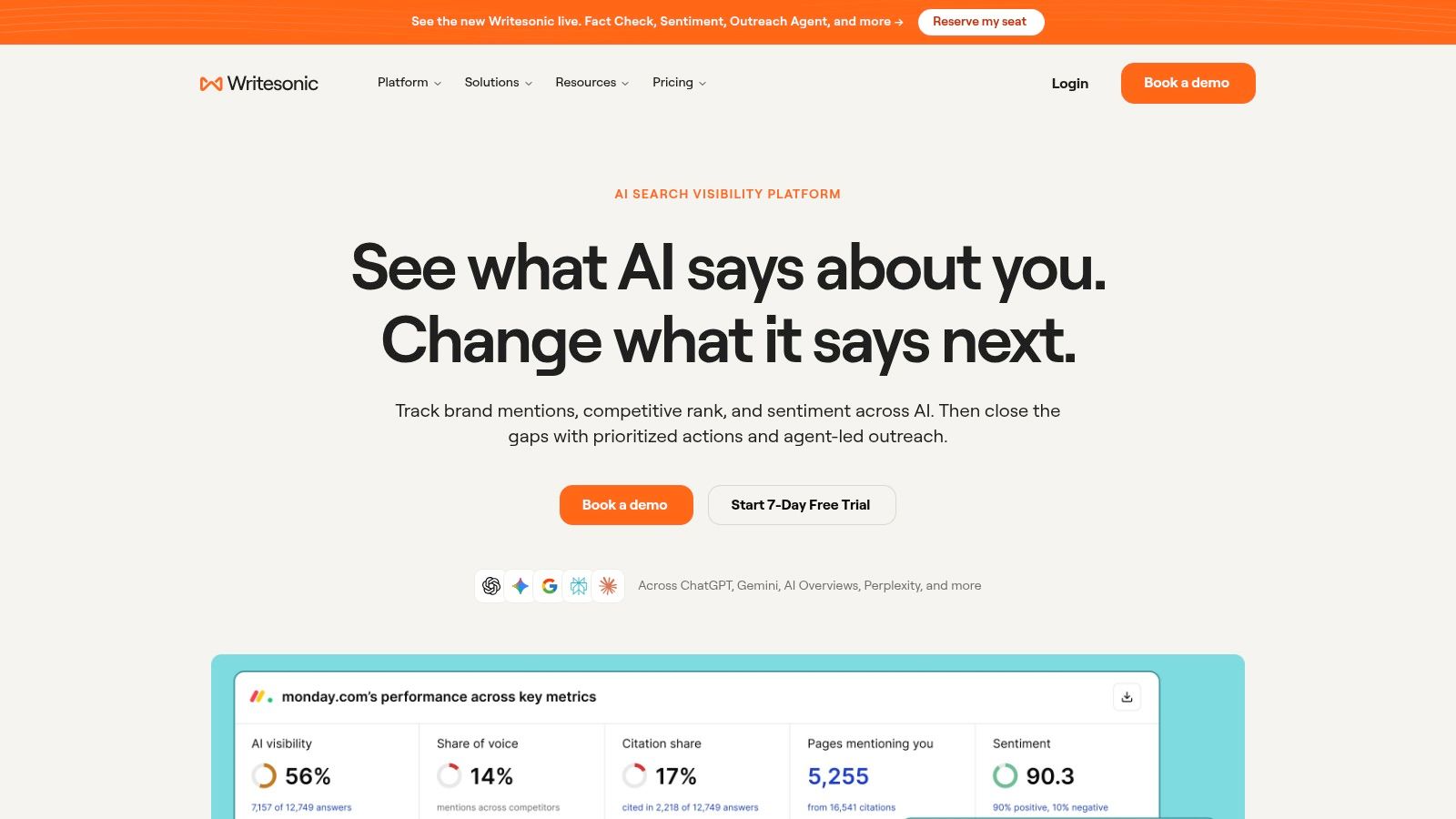
Writesonic pairs AI article production and site audits with brand visibility tracking inside AI search. It's the shortlist entry for marketers who want to publish and measure AI answer presence from one subscription instead of buying a content tool plus a separate tracking platform.
Rankings alone stopped being enough
An analysis of 300,000 keywords found the top-ranking page received 34.5% less average click-through when an AI Overview was present. If clicks thin out at position one, impressions without clicks, brand mentions, and citations inside AI answers become the numbers worth watching.
Track the prompts you want to win, not only the keywords you already rank for.
- Check before you commit: lower tiers cap users, projects, prompts, and audits, AI platform coverage changes from plan to plan, and the vendor lists a free trial.
- Editorial reality: generated articles need editing and verification before publication, and Google's spam policies apply to AI drafting tools exactly as they do to people.
Teams wiring AI into a wider marketing motion can pick up the workflow side from the guide to how to use AI in marketing.
The Best AI Tools for SEO at a Glance
The picks are sorted by job, not by score. Find the row that matches the bottleneck, then read the last column, since that trade-off is usually what decides whether the tool earns its subscription.
| Best for | Core strength | Watch out for |
|---|---|---|
| Surfer SEO directory listing: people exploring SEO tools | Hand-verified listings and side-by-side comparisons | An editorial profile, not a product trial; a listing guarantees no traffic or rankings |
| Semrush: teams combining SEO and AI visibility workflows | Keyword research, competitor analysis, audits, and AI visibility in one suite | Paid plans can be costly; broad feature set takes time to learn |
| Surfer: teams producing SEO-focused content | Search-informed content planning and optimization | Content scores do not guarantee rankings; not a full technical SEO suite |
| Ahrefs: users prioritizing SEO research and data | Keyword, competitor, backlink, and site-audit research | Paid plans can be costly; entry tiers cap features and usage |
| Frase: small teams managing content from research to review | Combines briefs, drafting, optimization, and audits | Plan caps differ between tiers; AI drafts need human review |
| Clearscope: established editorial teams | Structured content optimization and visibility tracking | High starting cost for occasional users; not a complete technical SEO suite |
| Writesonic: marketers combining content generation and AI visibility tracking | AI article workflows, site audits, and AI search visibility | Lower tiers cap users, prompts, and audits; generated content needs review |
Free entry points differ across the list. Frase runs a 7-day trial without a credit card, Ahrefs gives free access to verified websites, Semrush keeps some tools free, and Writesonic lists a free trial. Whatever the entry point, the trade-off in the last column predicts fit better than the trial length does.
Pick by Job, Then Verify Before You Buy
Start with the job that hurts most, not with the longest feature list. If research is the bottleneck, shortlist Ahrefs and Semrush. If drafts stall before they reach an editor, shortlist Surfer, Frase, and Clearscope. If the open question is whether AI answers mention the brand at all, start with Writesonic and add a dedicated tracker. Two tools from the matching group, run through each vendor's trial on one live page or one real keyword set, will tell you more than a month of reading comparisons.
Pricing and limits move constantly. The current numbers belong on the vendor's site, and the vendor's page is the only place to confirm what a plan includes today. Conductor's 2025 State of SEO Survey found 91% of respondents saying SEO positively affected website performance and marketing goals, which is an argument for buying carefully rather than quickly.
Get a second opinion before signing
Reviews and side-by-side comparison pages cut the risk of a bad pick. AI Tool Seekers is a hand-verified directory where every listing carries an Editor's Score split into Capability, Ease of use, Value, and Delivery sub-scores. Tools can be compared side by side on features, pricing, and Editor's Score, so a shortlist becomes a decision rather than a folder of open tabs.
If AI visibility is the open question, this roundup of AI citation tracking tools covers the monitoring side in more depth.
One step today. Write down the single SEO task that costs the team the most hours, open two trials from the matching category, and run both on that task this week.
Every listing on AI Tool Seekers is checked by a person, scored across capability, ease of use, value, and delivery, and published with real pros, cons, and pricing so you can compare AI SEO tools without guessing. The directory covers SEO alongside writing, marketing, and automation software, with free tools that include an AI visibility checker for the questions this article raises. Visit the AI SEO tools category, open two reviews, and put the comparison next to your shortlist before the next trial expires.