What Is AI Marketing: Uses, Benefits, Risks and Examples
What is AI marketing? Learn how it works, where it helps, the risks to manage and how to measure results before you commit.
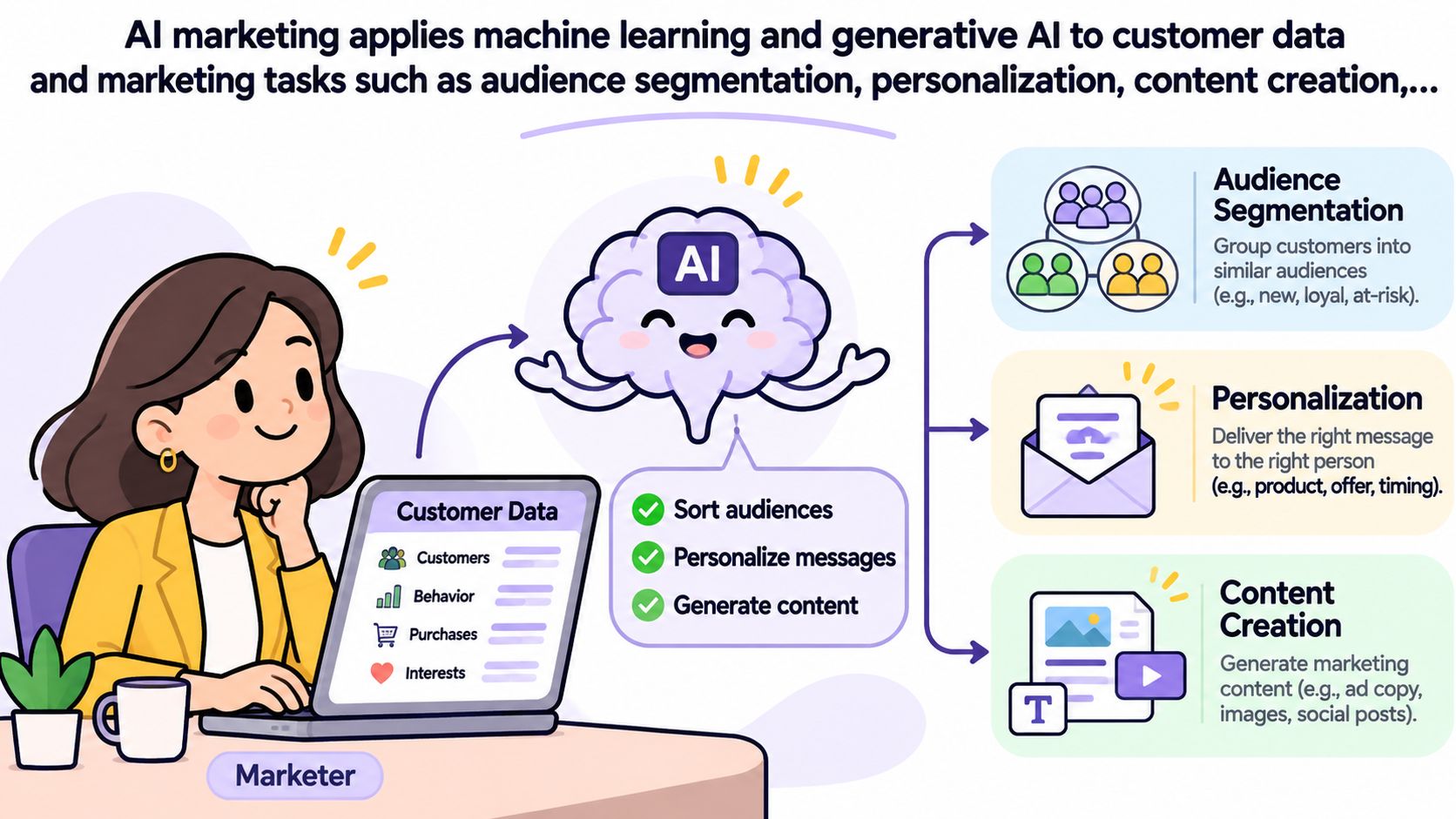
AI marketing uses machine learning and generative AI to analyze customer data and automate or improve marketing tasks such as segmentation, personalization, content creation and campaign optimization. Its real test isn't how many drafts a tool produces, but whether those actions improve measurable business results like conversions, retention, or revenue.
Every Monday morning, a small marketing team opens an inbox packed with vendor pitches promising faster campaigns and effortless growth. Business owners and managers ask what is AI marketing in daily practice, and whether those tools move sales or just fill channels with generic copy. Separating real commercial lift from busywork starts with understanding how these systems operate, where people must stay in charge, and how a team proves a tool pays for itself.
Table of Contents
- What AI Marketing Means in Plain Terms
- Which Marketing Tasks AI Changes
- How an AI Marketing System Works
- Real Examples of AI Marketing at Work
- Measuring Whether AI Marketing Pays Off
- Risks, Disclosure and Legal Limits
- Common Misconceptions About AI Marketing
- Choose One AI Marketing Task to Test First
What AI Marketing Means in Plain Terms
In plain language, AI marketing applies machine learning models and generative software to customer records and routine campaign work. It covers tasks like grouping audiences, personalizing offers, drafting copy, optimizing bids, and automating repetitive workflows.
The simplest way to separate AI from ordinary marketing software is a kitchen analogy. Standard marketing tools follow fixed rules a person writes in advance, like a printed recipe that only changes when someone edits the page. An AI system finds patterns in large datasets and adjusts recommendations or drafts with less manual setup, closer to a cook tasting a dish and adjusting the seasoning on the spot. Teams comparing fixed workflows with adaptive software can review marketing automation basics without enterprise pricing to see where traditional rule-based sequences end and machine learning begins.
Predictive AI Versus Generative AI
Teams encounter two branches of AI under the same label, and many combine both in a single campaign:
- Predictive AI: Forecasts customer behavior by spotting patterns in historical records, such as identifying which subscribers are likely to buy next or cancel an account.
- Generative AI: Produces draft text, images, product descriptions, or ad headlines based on prompts and brand guidelines.
Adoption has moved well past early trials. In 2025, 59.32% of marketers planned to increase their investment in AI, according to a survey cited in the Pixis 2025 AI marketing report. Wider business tracking shows the same shift, with McKinsey global research summarized in Shno's AI adoption statistics reporting that 78% of organizations used AI in at least one business function, up from 55% in 2023, while regular generative AI use rose from 33% in 2023 to 71% in 2024.
High adoption doesn't mean marketing runs on autopilot. Strategy, brand judgment, and final accountability still belong to people.
Which Marketing Tasks AI Changes
AI rarely replaces a full marketing role. Instead, it reshapes specific daily tasks while shifting human effort toward direction, editing, and verification.
| Marketing task | What AI does | Example | Human check |
|---|---|---|---|
| Audience segmentation | Groups customers by behavior and purchase signals | Separates lapsed buyers from new visitors | Confirm segment definitions match brand rules |
| Personalization | Adjusts message, offer or send time per segment | Different email for a shopper who viewed running shoes | Review sensitive product categories |
| Content creation | Drafts copy, images or product descriptions | Ten headline variants for one ad | Fact-check claims and edit for brand voice |
| Lead prioritization | Predicts which leads are likely to buy | Ranks leads for sales follow-up | Compare scores with closed deals |
| Campaign optimization | Shifts budget or bids toward better results | Moves spend away from weak ad sets | Hold out a control group |
| SEO research and content | Groups keywords and drafts outlines | Clusters related search topics | Publish original, useful pages |
| Reporting | Summarizes results and flags unusual changes | Flags a sudden drop in click-through | Confirm the cause before changing campaigns |
The financial upside centers on doing more granular work across those exact categories. McKinsey's economic potential of generative AI report estimates that generative AI could create marketing-function value equal to 5 to 15% of total marketing spending, driven mainly by personalization, content generation, and SEO improvements.
Where Human Checks Matter Most
Look closely at three tasks in the table to see why oversight can't be skipped. In audience segmentation and personalization, software groups buyers by browsing history and sends customized reminders, such as an email highlighting trail gear for someone who viewed running shoes. A marketer still has to review sensitive categories, like health or financial products, so automated messages don't feel invasive or cross compliance lines.
In content creation and SEO research, writing platforms such as Jasper and Copy.ai describe drafting ad variants and campaign copy on their websites, while SEO tools like Clearscope outline keyword clustering and topic briefs. Generating ten headlines takes seconds, yet a person must strip out unverified product claims, match brand tone, and ensure every published page adds genuine usefulness for readers.
In lead prioritization and reporting, predictive models rank inbound inquiries for sales reps and alert analysts when click-through rates drop suddenly. Reps still need to compare those scores against actual closed deals, and analysts must verify whether a traffic dip came from a broken tracking tag or a real market shift before moving budget. The table serves as a practical map of possibilities, not a guarantee that every job runs automatically.
How an AI Marketing System Works
Buying a single prompt box isn't the same as running a production AI marketing workflow. Real systems connect customer records, modeling, delivery, and controlled measurement in a repeatable loop.
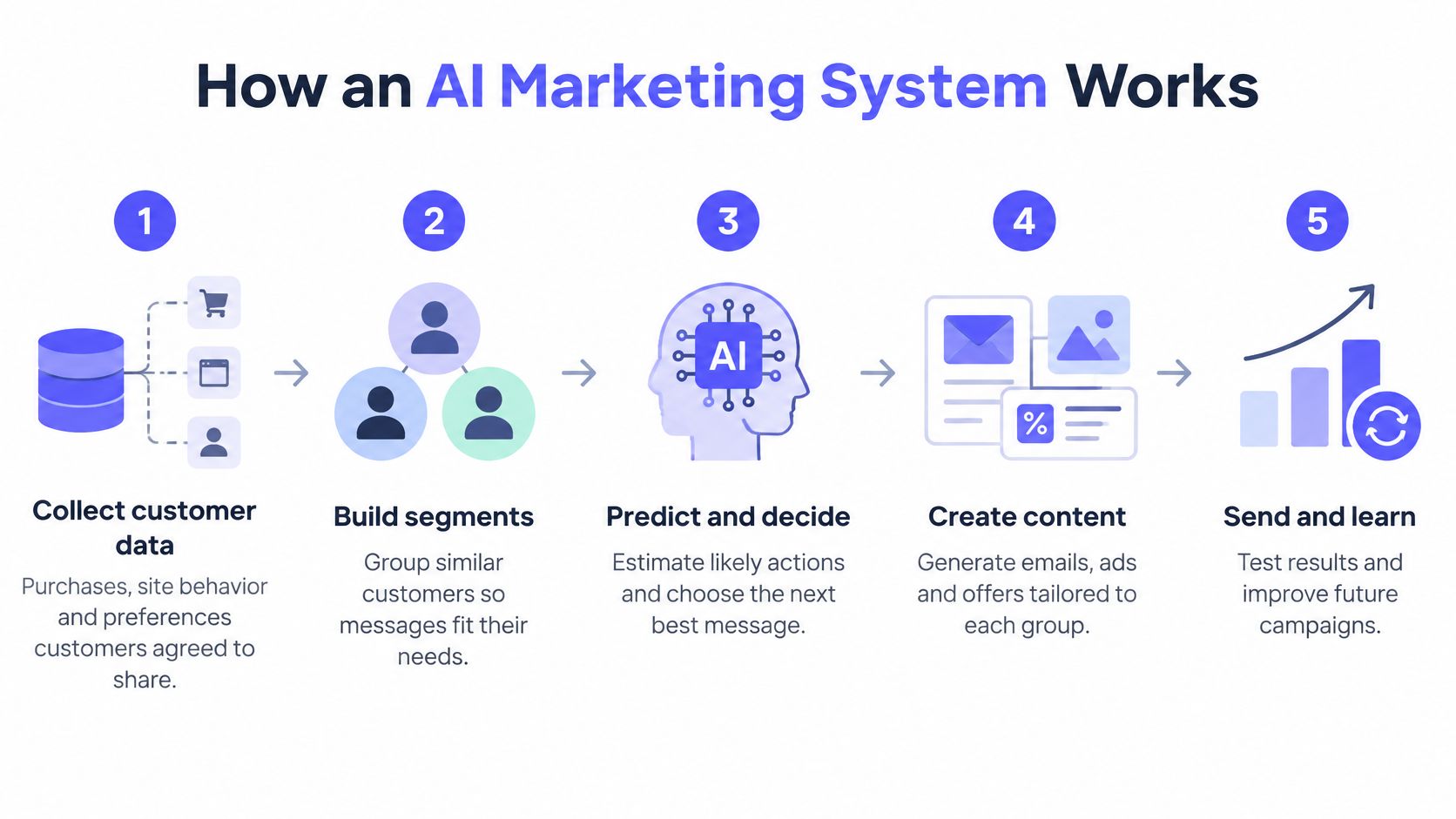
A structured setup typically moves through six stages:
- Collect customer data: Pull together purchase history, site visits, campaign clicks, and preferences customers agreed to share. Clean inputs matter because incomplete or outdated records skew every downstream decision.
- Build simple features: Turn raw logs into clear signals, such as how recently a buyer ordered, how often they return, or which product category they browse most. Models perform better on well-defined behavioral signals than on messy spreadsheets.
- Run a prediction or recommendation model: Estimate the probability that a specific customer will click, convert, churn, or ignore an offer. This step replaces guesswork with ranked likelihoods.
- Apply a decision engine: Choose the actual message, offer, channel, and delivery time by weighing predicted response against expected margin and contact frequency limits. Agencies pairing predictive targeting with structured outreach often study systems like outbound lead generation for agencies to keep message cadence and channel rules disciplined.
- Deliver the message and log outcomes: Send the chosen email, ad, or on-site offer and record every open, click, unsubscribe, and purchase. Without reliable event logging, the system can't learn what worked.
- Measure against a holdout group: Keep a randomized share of eligible customers out of the AI-selected campaign and compare their purchases to the exposed group. Relying only on last-click attribution gives credit to sales that would have happened anyway.
Adding Generative Variants Without Losing Control
Generative models plug into the fourth and fifth steps. Instead of writing one static email for an entire mailing list, a team generates three or four copy variants for distinct audience segments, then feeds them through the exact same controlled test.
The most common slip happens when a team skips the holdout group during a busy shopping season. Sales climb in November, the dashboard turns green, and everyone credits the new AI tool for a seasonal surge that arrived on its own.
Measurement rule: Without a randomized holdout group, a marketing team can't tell whether AI created new demand or simply took credit for existing buyers.
Real Examples of AI Marketing at Work
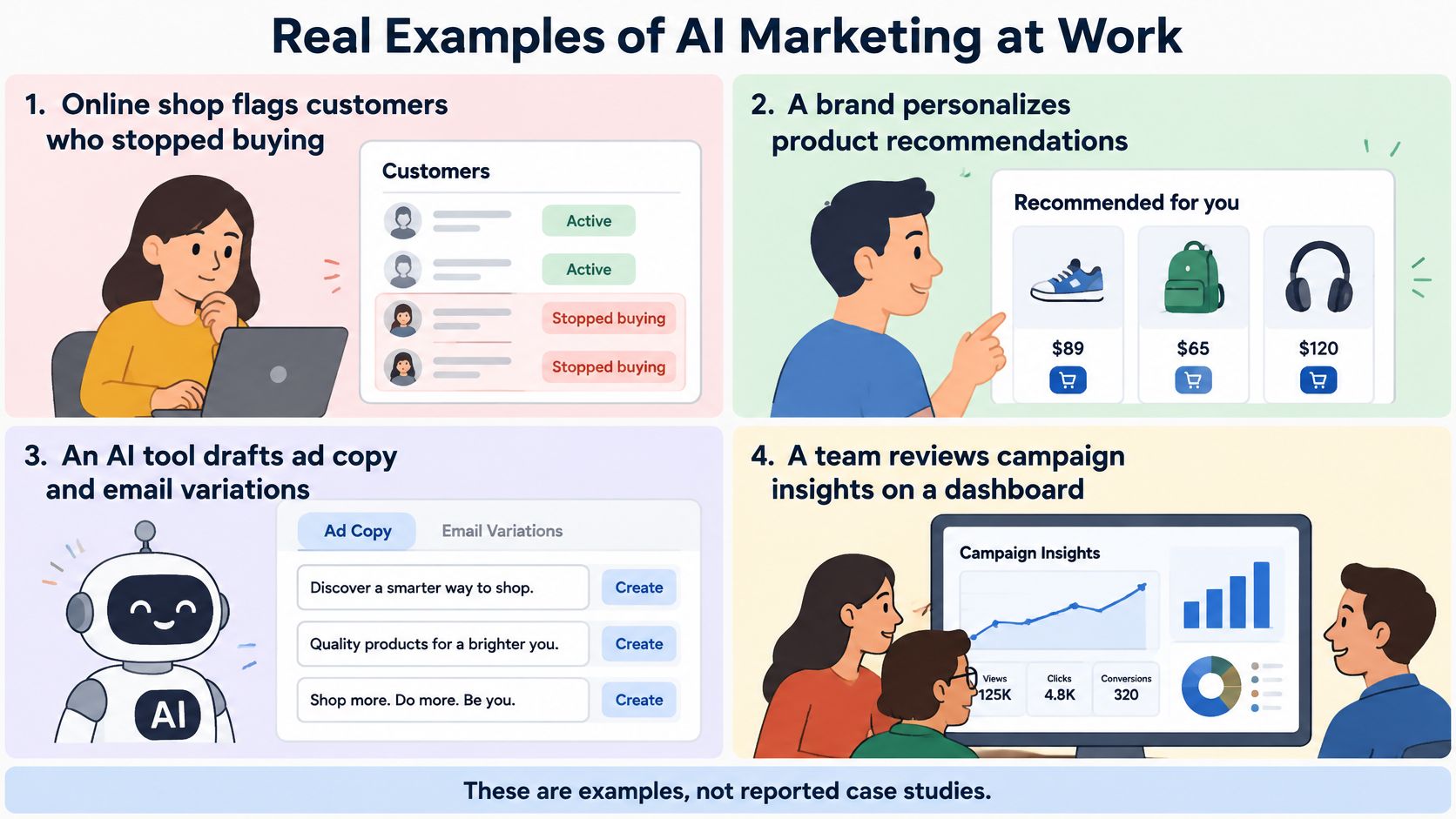
The four scenarios below are illustrative examples built to show how human review and testing fit into daily campaigns. They aren't reported corporate case studies.
E-commerce Win-Back Email
An online footwear store notices repeat orders slipping among past buyers. A predictive model identifies shoppers who haven't purchased in three months and drafts a personalized reminder highlighting restocked sizes. Before the send goes live, a marketing coordinator checks discount margins and excludes customers with open support tickets. The team holds back a random slice of lapsed buyers who receive no email, then compares repeat orders between both groups to measure real lift.
B2B Inbound Lead Scoring
A software vendor receives hundreds of demo requests and whitepaper downloads each week, overwhelming a small sales desk. An AI scoring model ranks leads using firmographic details, pricing page visits, and webinar attendance so reps call the highest-scoring accounts first. Each month, a sales operations lead audits closed-won deals against the model's rankings to confirm top scores convert at a higher rate instead of rewarding casual browsers.
Paid Social Headline Testing
A consumer skincare brand needs fresh ad copy for a spring launch. Generative software drafts ten headline options focused on different product angles. A copy editor removes two lines making unproven medical claims, tightens brand voice across the rest, and selects three variants for a split test. The team judges the winner on cost per completed purchase rather than cheap clicks.
Search Content Outlines
A small publishing team wants to cover core buyer questions across its blog. An AI assistant clusters related search queries and produces structured outlines. An editor adds firsthand product guidance, verifies every technical detail, and discards thin sections before publishing. Organic leads and time on page show whether readers found the guides helpful. Readers exploring broader operational workflows can also review practical AI automation examples to see how similar human checkpoints apply outside campaigns.
Across retail, B2B software, and publishing, the same three-beat pattern holds: software speeds up analysis or drafting, a person enforces quality and rules, and a controlled metric proves the outcome.
Measuring Whether AI Marketing Pays Off
Say a marketing team uses generative tools to cut ad production time in half, yet quarterly revenue doesn't budge. That team scored an efficiency win without an effectiveness win. Telling those two outcomes apart keeps budgets focused on revenue rather than output volume.
| Metric type | Example measures | Question it answers |
|---|---|---|
| Efficiency | Time and cost per asset | Did production get faster or cheaper? |
| Effectiveness | Incremental conversion against a holdout group | Did AI create sales that would not have happened? |
| Customer value | Revenue per exposed customer and customer lifetime value | Did AI improve what each customer is worth? |
| Retention | Repeat purchase rate and churn | Did customers stay longer? |
| Quality and risk | Error rate and brand complaints in generated copy | Did AI add errors or off-brand messages? |
| Fairness | Results compared across customer segments | Did any group receive worse offers or treatment? |
Industry projections show why teams chase effectiveness carefully. In its AI-powered marketing and sales report, McKinsey notes that organizations investing in AI have been associated with 3 to 15% revenue uplift and 10 to 20% sales-ROI uplift, alongside substantial broader sales and marketing productivity potential. Those numbers are opportunity estimates and associations, not guaranteed results for every business.
Why Strong Pilots Fail to Scale
A tidy pilot on one email list often stumbles when expanded. Messaging that works in English paid search may miss cultural norms in another region, underperform on social feeds, or trigger compliance hurdles in finance and healthcare.
Teams also need ongoing guardrails once a campaign scales. Tracking hallucination rates, factual error counts, and customer complaint tickets catches bad copy before it damages brand trust. Comparing offer values and conversion rates across customer segments reveals whether a model accidentally excludes or overcharges a specific group.
Write down the primary business metric and the holdout group before launching any AI campaign. If a tool only shifts labor from writers to reviewers, the numbers will show it quickly.
Risks, Disclosure and Legal Limits
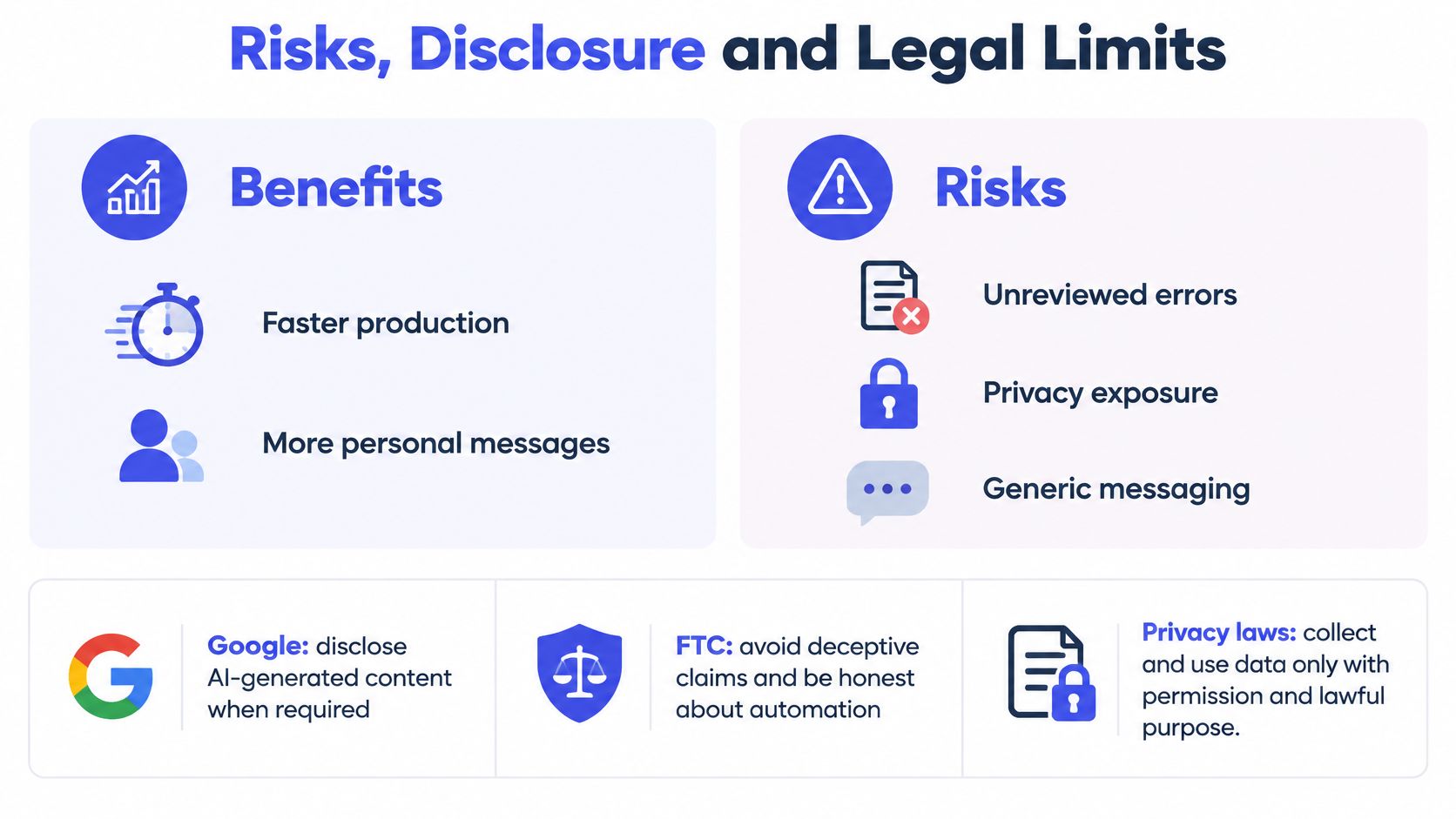
AI marketing brings real trade-offs. Faster asset production and tighter message relevance sit on one side; unreviewed factual errors, privacy exposure, and bland, look-alike messaging sit on the other.
Three Rule Sets Every Team Must Respect
Using automation doesn't create a loophole around platform policies or consumer protection laws. Three established frameworks set clear boundaries:
- Search engine spam rules: According to Google's guidance on using AI-generated content, using automation, including AI, with the primary purpose of manipulating search rankings violates Google's spam policies. Google also recommends giving users context when content is automatically generated, such as explaining how automation was used or adding image metadata.
- Commercial email compliance: Under the FTC's CAN-SPAM Act compliance guide, commercial emails must clearly and conspicuously identify a message as an advertisement when applicable and include a clear explanation of how recipients can opt out of future emails. Software that drafts or personalizes promotional emails doesn't remove those obligations; the marketer stays legally responsible.
- Automated decision-making limits: Under the UK ICO guidance on automated decision-making and profiling, a solely automated decision that produces a legal or similarly significant effect on an individual is restricted under UK GDPR, including when profiling is involved. Tailoring marketing to a person counts as profiling, though Article 22 restrictions turn on whether the decision lacks meaningful human involvement and reaches that significant-effect threshold, with explicit consent noted as one narrow basis that can permit certain solely automated decisions.
Practical Governance Controls
A lightweight governance routine prevents most avoidable mistakes without slowing down small teams:
- Named human approver: Assign one person to sign off on every AI-assisted campaign before launch.
- High-risk review gate: Require legal or senior editorial review for regulated industries, pricing claims, and brand-sensitive announcements.
- Output and prompt log: Keep a simple record of what the AI generated, what data fed the workflow, and what a human edited before publication.
Common Misconceptions About AI Marketing
Newcomers often hear sweeping claims from software ads that don't hold up in daily operations. Four misconceptions cause the most wasted budget.
AI writes and runs all the marketing. In reality, software drafts options and scores probabilities while people set strategy, verify product facts, and decide what deserves a customer's attention. Optimizing blindly for a short-term proxy like clicks can drive cheap traffic that never buys and erodes long-term retention.
More AI output automatically means better marketing. Producing triple the emails or blog posts won't lift revenue if quality drops. In a 2025 SAS survey of marketers, 93% of CMOs and 83% of marketing teams using generative AI reported seeing ROI, yet only 8% of organizations had a strong governance framework and 48% of marketers reported governance concerns. Without review and testing, automation scales generic copy and factual slips just as quickly as good ideas.
Labeling content as AI-generated automatically builds trust. Transparency isn't a magic switch. Research from the Nuremberg Institute for Market Decisions reports that labeling content as AI-generated doesn't automatically increase trust and can sometimes have the opposite effect. In a representative study of 1,000 people each in the United States, United Kingdom, and Germany, only 44% knew AI could create marketing content like ads or social posts, only 21% trusted AI companies and their promises, and just 20% trusted AI itself. Context shapes consumer reaction too, as a 2025 University of Florida study of more than 1,100 participants noted in the same research found that transparency, perceived realism, familiarity with AI, and personalization needs can positively predict trust depending on the audience.
Personalization is always welcome. Personalized product reminders help busy shoppers, yet hyper-specific offers or excessive message frequency can feel creepy and push subscribers to opt out. Testing tone and cadence protects goodwill.
Practical takeaway: A generic "made with AI" badge won't save weak marketing. Accurate claims, clear explanations of AI's role, and visible human oversight earn far more trust.
Choose One AI Marketing Task to Test First
The smartest starting move isn't rebuilding an entire marketing stack at once. Pick one focused task, such as lead prioritization for a sales queue or subject line testing on a weekly newsletter, where inputs are clean and outcomes are easy to count.
Before signing up for software, write down one primary effectiveness metric and reserve a small holdout group. Run the pilot for a fixed window, such as four to six weeks, then have a named manager review both the lift numbers and any editorial errors before expanding.
When evaluating software options, readers can browse the best AI marketing tools on AI Tool Seekers, a hand-verified AI tools directory. Alongside individual tool reviews, alternatives, and comparison pages, AI Tool Seekers offers four free utilities: an AI readiness checker, an AI tool finder, an AI cost calculator, and an AI visibility checker. Readers should check each tool's review and alternatives page for updated features, then verify current pricing, plan limits, and free trial terms directly on the vendor's website because software offers change frequently. Directory listings reflect hand-verified review and editorial opinion with zero pay-to-rank slots, aren't professional advice, and don't guarantee campaign results. A small, measured trial beats a broad rollout built on hope every time.
AI Tool Seekers maintains a hand-verified directory of AI software with structured Editor's Scores, side-by-side comparisons, and free planning utilities built to help teams match real marketing problems to the right tools. Readers preparing a first pilot can compare options by task, inspect pros and limitations without paid rankings, and narrow a shortlist in minutes. Explore reviewed marketing software and free planning utilities at AI Tool Seekers.